

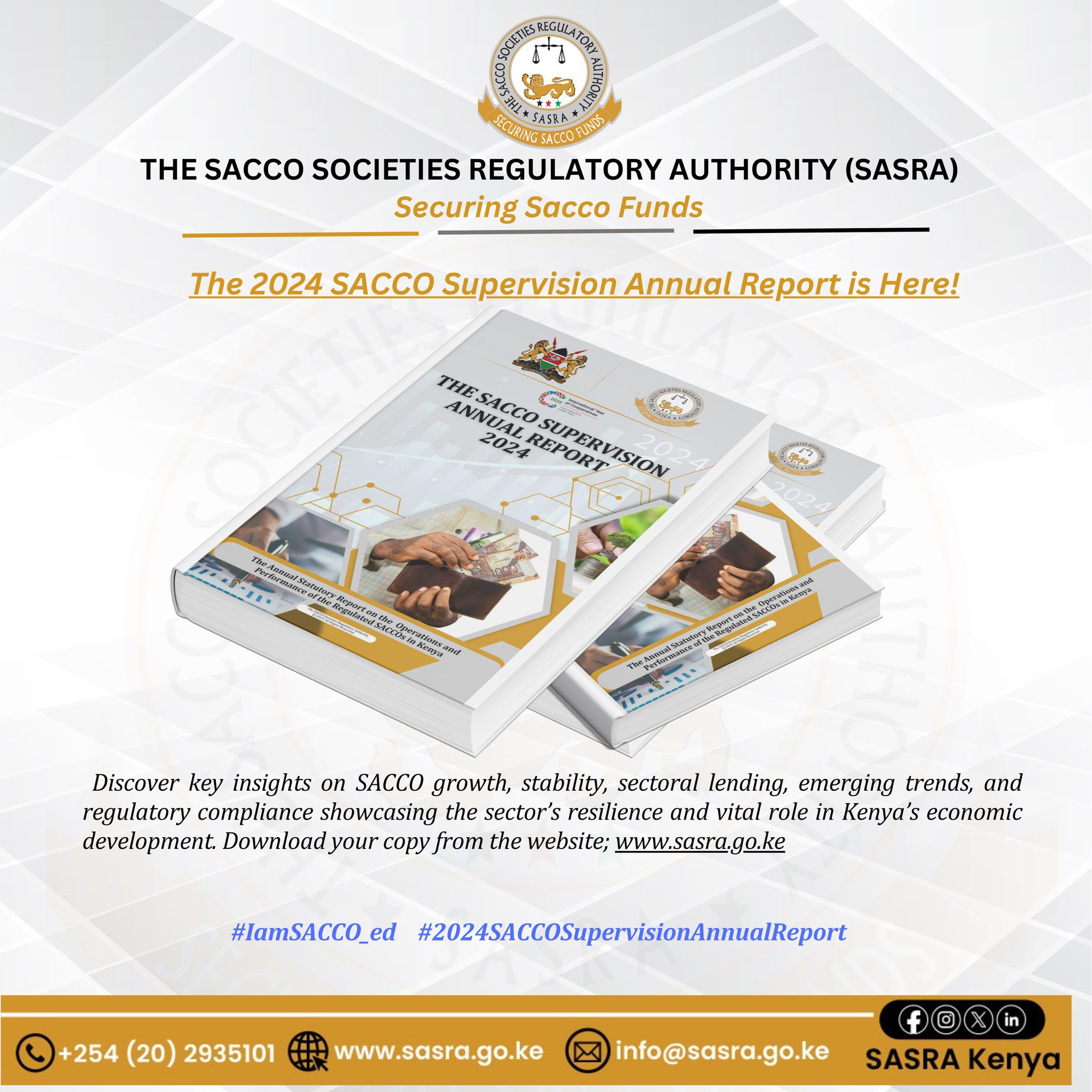
Let me start by saying that the release of the SACCO Supervision Annual Report, 2024 today marks another important milestone in the Kenyan Cooperative sector. Firstly, the release of this Report comes at a time when the Cooperative movement is marking the 2025 United Nations International Year of Cooperatives, which provides the action plan and deliverables during the celebrations and beyond. Secondly, the release of the report marks 10 years-post the transition period of June 2014, when the full implementation of prudential regulations of SACCOs in Kenya commenced.
Consequently, this is an occasion to critically take stock of the performance, operations and activities of the SACCO industry in Kenya, not just over the last one (1) year, but over the last decade. It is also an opportune time to reflect on the future outlook of the SACCO sector in the short and medium term, by taking into account national and international macro-policy developments.
There is no doubt that the Regulated SACCOs have made notable gains over the decade and this is commendable. For instance, during this period –
- The number of members in Regulated SACCOs grew to 7.40 million people in 2024 from just under 3.08 million members in 2014.
- The total assets grew to Kshs 1.08 trillion in December 2024 from a paltry Kshs 301.54 billion in 2014. And as at August 2025, total assets had increased to Kshs 1.13 trillion.
- The total deposits grew to Kshs 749.43 billion in 2024 from just about Kshs 205.97 billion in 2014. As at August 2025 total deposits had grown to reach Kshs 806.37 billion.
It is also laudable to note from the Report that the Regulated SACCOs have largely embraced the use of ICT in their financial services delivery. This has widened the reach of financial services and products offered by SACCOs in Kenya, thereby deepening financial inclusion in the Country.
It is also noted from the Report that Regulated SACCOs are shunning away from the use of traditional expensive brick and mortar branches to the more affordable, innovative and technologically driven “SACCO Agencies”, to deliver financial services and products to their membership. In particular, I take keen note that there were 4,247 SACCO agents spread out across the country in 2024, and with transactions worth over Kshs 31.65 billion for and on behalf of the Regulated SACCOs.
Ladies and Gentlemen,
Let me emphasize the fact that the usage of ICT in the provision of financial services is the way to go, in current age and times. ICT and electronically enabled financial services offers customers ease and convenience of doing business including access and usage. It also reduces costs and expenses associated with physically offered financial services, while at the same time being attractive to the younger generation joining or intending to join SACCOs. Lastly, it re-positions SACCOs’ existing comparative advantages to ward-off competition from other financial institutions such as commercial and micro-finance banks and Digital Credit Providers.
Consequently, my Ministry will continue to support SACCOs to adopt, deepen and embrace the usage of safe and secure ICT in their financial products and services offering. This is also aligned to the national government’s digital economy vision as enshrined in the Bottom-Up Economic Transformation Agenda (BeTA).
As we do this however, SACCOs and the entire industry players must continue to be wary of the cyber-threats which lurks behind the usage of ICT and fintech in provision of financial services and products. On this note, I am happy to report that the National Computer and Cybercrimes Coordination Committee (NC4) chaired by the Principal Secretary, Interior, has designated SASRA as the SACCO sub-sector Cyber Security Operations Centre under the Computer Misuse and Cyber Crimes Act made thereunder.
This has substantially decreased cyber security incidents within the SACCOs industry over the last 18 months, and I do urge all SACCOs and SASRA to maintain this vigilance.
Ladies and Gentlemen,
Despite these many milestones recorded in the SACCO industry, there is still a lot more to be addressed in order to fully secure the SACCO sector.
To start with, it is important to observe that this Report relates to only 355-Regulated SACCOs consisting of the 177-Deposit-Taking SACCOs and the 178-BOSA-Only SACCOs with deposits above Kshs 100 million. In other words, there are many other BOSA-only SACCOs whose deposits are below the Kshs 100 million threshold which are not under the prudential supervision of SASRA. My Ministry is therefore looking into modalities of bringing this segment of SACCOs under SASRA.
Of course, I have been made aware that a majority of these BOSA-only SACCOs have very small balance sheets. This implies that they cannot generate sufficient resources or revenue required to comply with the prescribed prudential regulation standards, ability to deploy ICT in their operations, meet members’ needs, expand operations among others. Am also aware that some of these SACCOs do not have the technical know-how to assure compliance with prudential regulatory parameters.
It is for this very reason among others that the Committee of Experts is to review the SACCO Societies Act and the Regulations and also to explore the ways and means of coming up with a shared technological services platform for these small SACCOs. Such a platform will provide a solution to the very many small and medium sized SACCOs across the country to come under the purview of prudential regulations, by enjoying the synergies associated with economies of scale of sharing common services.
Indeed, it is worthwhile to note that even among the 355-Regulated SACCOs, a total of 216 of them have relatively small balance sheets of less than Kshs 1 billion in assets totalling to Kshs 79.66 billion which is only 7.40% of the total assets. Such small balance sheets undermine their competitiveness in the credit business, which today heavily runs on very robust ICT and technological platforms – but which these SACCOs can hardly afford.
Ladies and Gentlemen,
As I have said, a shared technological services platform will come in handy in assisting these small-sized SACCOs meet regulatory burden and withstand competition in the financial services space.
However, we must be alive to the reality, that there seems to be very many small BOSA-only SACCOs spread across the Country, but which are inactive and exist just on paper. The few active ones are neither stable nor financially viable because they serve just a few members, with limited impact on financial inclusion.
Consequently, a time has come for the SACCO sector to explore market driven solutions of consolidations and mergers of these very many small BOSA-only SACCOs. This is the only way to ensure their financial viability and stability.
In this regard, I urge officials of SACCOs operating within the same or similar traditional economic and social common bonds, to immediately start conversations relating to mergers as a solution to their survival.
To this end, am happy to report that under SASRA’s guidance, one such small-sized Regulated SACCO in Kirinyaga County recently merged with a larger, more stable and dominant Regulated SACCO. As a result, the members of the smaller SACCO are now able to be effectively and efficiently served through appropriate and affordable financial services and products. This is the way to go, in order to have a prosperous SACCO sector.
At the Ministry level, we have issued a temporary moratorium on the registration of new SACCOs, and not all cooperatives, in order to take stock of the existing registered SACCOs and see where they are as well as assess their viability. Those which are only registered by name but are not active will be de-registered and liquidated by the Commissioner for Cooperatives as required by law. Those which are active and viable will be required to be supervised by SASRA, otherwise they shall equally be de-registered and liquidated.
Let me make it clear that SACCOs are just one of the many typologies of Cooperatives in Kenya, and I have seen the Report being released today has clearly unpacked this in Page 24 for purposes of the readers. And so, the moratorium on registration relates to SACCOs, because of their financial mediation business involving collecting deposits from the public and intermediating the same as loans, which calls for government intervention to protect the said deposits.
It is therefore in the same breadth that the Committee of Experts is expected to also revisit the current thresholds for registration of a SACCO – which today is capped at just ten people. Is this sustainable?
On the same note, I do know that there are several Transport Cooperatives, which are currently registered or operating as Matatu or PSV SACCOs. These entities are not SACCOs because they are not engaged in mobilization of deposits and/or intermediating the deposits as credit. They are simply an association of people coming together to operate transport business or manage routes as required by the National Transport Safety Authority (NTSA).
Consequently, the continued usage of the name “SACCO” by these entities brings a lot of confusion and we must take immediate steps to rectify the situation. It also causes confusion among members of the public and may result in reputational damage to SACCOs as regulated and credible financial institutions.
In view of the foregoing, and to bring sanity in the SACCO industry, the Ministry is going to transform all existing “Matatu or PSV SACCOs” which are not engaged in any “savings and credit business” into “Transport Cooperatives” or Transcoops”. Those which are genuinely engaged in savings and credit business will however be required to apply to be regulated by SASRA or else face deregistration.
Ladies and Gentlemen,
As a Ministry, we commit to do what is possible within the prevailing legal framework to protect the deposits of members of the public held in Regulated SACCOs. But we equally call upon the public to cease and desist from undertaking or transacting SACCO business with unregulated and pyramid-styled entities purporting to be SACCOs when they are not.
In this regard, I am aware that SASRA has on a continuous annual basis been publishing the list of Regulated SACCOs in the Country both in the Kenya Gazette and the National Newspapers as required by law and has also availed the same on website.
Ladies and Gentlemen,
Governance in SACCOs is still a matter of grave concern for the government. It is important to emphasize that SACCOs can only thrive in an environment where good governance practices are fully engrained and practised.
I do know that both SASRA and the Commissioner for Cooperatives have issued various circulars and guidance notes on Good Governance practices for Regulated SACCOs, which are aligned to and tailor-made for SACCOs as cooperative enterprises. Whereas the many SACCOs have embraced these circulars and guidance notes, others have not, with devastating consequences. For example –
- The Annual General Meetings – Whereas this is the supreme organ of all SACCOs where critical decisions are made, there are some SACCOs with tens and hundreds of thousands of members. It is in this regard that the Ministry directed SACCOs with over 5,000 members to adopt the delegate system to ensure that the general meetings are forums for effective decision making.
- Payment of Dividends – I have noted with concern that there are SACCOs that have been engaged in an unhealthy financial competition in payments of dividends on shared capital and interests on deposits. SACCOs are “for service entities”, and the key services offered are provision of “savings” and “credit”. They are not for profit, and should therefore not offer unsustainable dividends and interests. This trend has seen some SACCOs engaged in unsafe and unsound practices, such as “cooking the books” to inflate revenues; borrowing to pay dividends; failing to retain statutory reserves among others.
In this regard, I have already directed the Commissioner and SASRA to ensure that no SACCO pays dividends or interest, unless they have made sufficient surplus, met the capital adequacy requirements, and made provisions for statutory reserves.
No SACCO shall be allowed to borrow from external sources to pay dividends, and henceforth any SACCO intending to procure an external loan must obtain written approval from the Commissioner, subject to compliance with the prescribed ratios.
- Board of Directors and Management – whereas we accept that democracy is part and parcel of the Cooperative Principles, there is need to seriously look into the calibre of persons being elected to the Boards of SACCOs, sometimes with no reference to their fitness and propriety. The need for serious and perhaps mandatory continuous professional development of key officers of SACCOs must also be revisited and implemented.
- Auditing – Both internal and external auditing are critical aspects which ought to support good governance practices. As an auditor of many years, these two (2) functions are usually considered to be the eyes of the Board and members. However, recent events which have seen the loss of funds in some SACCOs, point towards what can be termed as “cooking of books” by the preparers of financial reports and statements, while the internal and external audit functions look the other way.
In this regard, I am directing the Commissioner and SASRA to reign-in on both internal and external auditors who fail to secure correct and accurate financial reporting by Regulated SACCOs. As an entry point, the Commissioner and SASRA must immediately –
- ensure that all financial reports and statements are counter-signed by the Chief Executive Officers and Finance Officers who prepared them, in addition to the Board of Directors. This will hold both management and the Board of Directors responsible for the disclosures in the statements.
- ensure that internal auditors of SACCOs render their opinions on the financial statements and reports, prior to such financial statements being subjected to external auditing.
- institute appropriate actions against external auditors who internally fail to render external auditing services in accordance with the SACCO Societies Act and Regulations including referral of such external auditors to ICPAK for addition sanctions.
Ladies and Gentlemen,
Since my appointment to this Ministry last year, I have had opportunity to benchmark with other Countries with mature SACCO financial ecosystems such as Ireland and UK. My experience from these Countries is that a financially functional, robust and stable SACCO financial eco-system consists of the following ingredients–
- A Prudential Regulatory framework;
- Shared Services Platforms driven by the industry and market players;
- the Central Liquidity and/or Stabilization facilities; and
- A functional Deposit Insurance scheme.
In Kenya today, we only have one part of the ecosystem namely the Prudential Regulatory Framework. The other three (3) are missing. Interestingly, the banking system which is largely regulated in the same manner as the SACCOs has all the four (4). It is therefore the turn of the SACCOs to pull all their resources to ensure that these three (3) key cogs are also realised. Fortunately, the Committee of Experts are already on course to review this, and I urge all of us to provide them with maximum support.
Ladies and Gentlemen,
Let me conclude by observing that the non-remittance menace is still with us, despite several concerted efforts to deal with it. In particular, I do note that for the period ended December 2024 about 85-Regulated SACCOs were owed a total sum of Kshs 3.49 billion up from Kshs 2.59 billion in 2023, affecting a total of 55,602 members.
This has seriously undermined the financial stability of the affected SACCOs, resulting in their inability to meet the obligations to members. It also impairs the capacity of the affected members to access financial services and products from their respective SACCOs. The most affected SACCOs are those that draw membership from County Governments and Assemblies which owed over Kshs 1.69 billion, and the Public Universities and Tertiary Colleges which owed over Kshs 762.27 million.
It is our anticipation that the Cooperative Bill 2024 will be fast-tracked in order to provide long-term solution to the affected SACCOs. In the meantime, I do urge SACCOs especially the DT-SACCOs to adopt and implement the Administrative Circular issued by SASRA in 2019, on recoveries of member deductions through FOSA channels, rather than reliance on deductions by employer-institutions.
With those very remarks, let me now declare the SACCO Supervision Annual Report, 2024 officially released to the public. Let me also invite policy makers, think-tanks and even the media to critically read the Report and utilize the data provided as tools for evidence-based policy dialogues and discourse. To the members of the SACCOs and public, the Report provides you with a one-stop shop for analysing the performance of your respective SACCOs and gives you sufficient information to hold your elected representatives in the SACCOs accountable.
Thank you very much and God Bless Kenya