
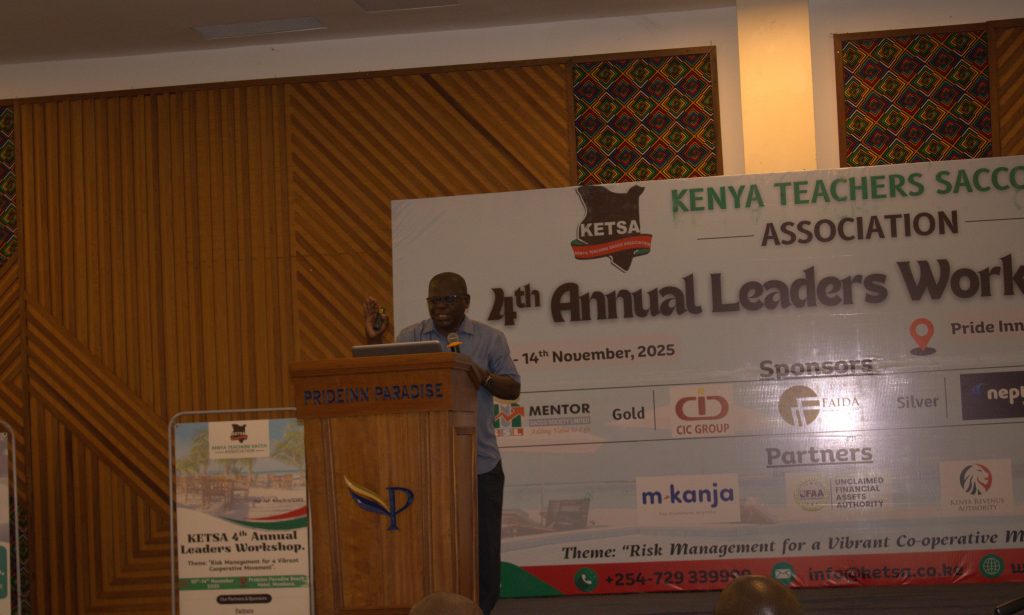
At the Kenya Teachers Sacco Association (KETSA) Leaders Conference in Mombasa, Mr. Jeckones Donge delivered one of the most thought-provoking sessions, urging Sacco leaders to reflect deeply on the legacy they will leave behind when their time at the helm comes to an end. His message, anchored on personal financial discipline, institutional sustainability, and visionary leadership, resonated strongly with participants.
Mr. Donge began by confronting leaders with a blunt but necessary self-examination. “What will you leave behind after being a director or senior staff member of your Sacco?” he asked. “Will you look back and see a wealthy membership and a rapidly growing institution—or will your exit be celebrated as good riddance?”
He challenged leaders not only to think about the Sacco’s growth but also about their own personal financial stability after leaving office. According to him, poor financial discipline among leaders weakens both their moral standing and the institution they serve. “If a Sacco leader does not utilize their loans properly, they lose the moral authority to guide members. They risk becoming perpetually broke, and that becomes a danger to themselves, their families, and the Sacco,” he warned.
Personal Financial Management: The Foundation of Trustworthy Leadership
Mr. Donge emphasized that prudent personal financial management is not optional for leaders—it is a necessity. Effective cash-flow planning, he said, ensures that individuals can sustain themselves between income cycles, while disciplined saving and investment habits build long-term stability.
He noted that proper financial behaviour by leaders has a ripple effect across the entire Sacco: increased savings mobilization, healthier loan utilization, and sustainable wealth creation. In his words, “Sustainable wealth creation ensures that all of us—leaders and members—are winners.”
Why Even Educated People Must Revisit Financial Discipline
Addressing a common misconception, Mr. Donge explained why conversations about savings and wealth creation are still necessary even among educated Sacco members. Many employees assume they will earn a salary until retirement at age 60, yet job losses can happen at any moment. Many entrepreneurs believe their businesses cannot fail—until they do. And too many people, he observed, live “extravagant, wasteful, and destructive lives… happy living on the surface of economic life.”
He reminded members that financial stability is shaped by six pillars: expenditure, savings mobilization, loan intake, loan utilization, investment, and retirement planning.
Economic Vision and Long-Term Sustainability
A leader’s economic vision, Mr. Donge explained, determines whether both the Sacco and its members achieve sustainable growth. A clear vision motivates the creation of well-defined projects, complete with costs, funding sources, timelines, and execution strategies. Visionary leadership, he said, involves “working with the end in mind: save, spend, invest, and actualize projects that will continue to generate revenue for your family’s short- and long-term needs.”
Succession Planning: A Must-Have Risk Management Tool
One of the most impactful parts of Mr. Donge’s presentation centered on succession planning. He defined it as the structured process of identifying, developing, and preparing new leaders to take over when current leaders exit—whether through retirement, redeployment, dismissal, or death.
Effective succession planning ensures there is “no vacuum in management and no disruption in operations,” he explained. It includes evaluating staff skills, identifying gaps, and training individuals to fill critical leadership roles when the time comes.
Leadership That Leaves a Legacy
Mr. Donge described the kind of leadership that leaves a lasting, positive mark on the institution:
- One that builds strong structures, policies, processes, and systems.
- One that produces consistent business growth anchored on solid governance.
- One that practices transparency, accountability, and zero tolerance for mediocrity, tribalism, or favouritism.
- And most importantly, one that plants seeds for future success through objective succession planning.
Such leaders, he said, are remembered fondly, respected for their integrity, and missed when they leave—not celebrated for their departure.
The Truth About Retirement
Mr. Donge dismantled common myths surrounding retirement. It is untrue, he said, that a Sacco will collapse without a particular leader. However, it is very true that a leader can retire into poverty if they fail to manage their finances well during their working years. Retirement can also bring unnecessary crises—property auctions, loan distress, and marital strain—if leaders have misused loans or neglected long-term planning.
But he also shared a hopeful truth: “You can be more useful and live an even better socio-economic life if you invest in you, for you and your family.”