

Proposed legislation would establish inter-Sacco liquidity institutions, tighten deposit protection, and overhaul regulatory oversight in the country’s multi-trillion-shilling co-operative savings sector
Parliament is considering sweeping reforms to the country’s Sacco sector that would, for the first time, create a formal legal framework for apex financial institutions owned and operated by Sacco societies themselves — entities capable of holding deposits, settling payments, lending between Saccos, and even participating in the inter-bank market.
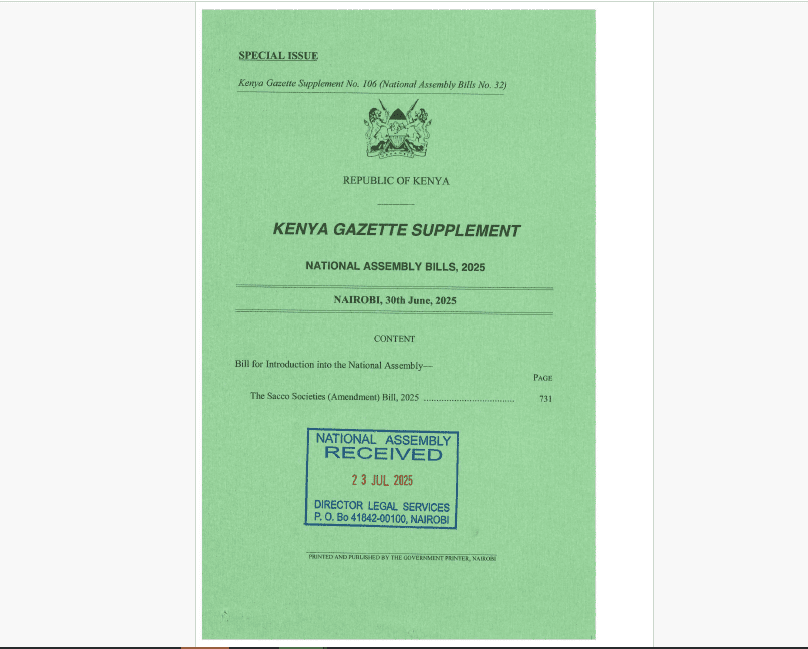
The Sacco Societies (Amendment) Bill, 2025, published in the Kenya Gazette on June 30, 2025, and received by the National Assembly on July 23, 2025, was tabled by Kimani Ichung’wah, the Leader of the Majority Party. If enacted, the Bill would introduce some of the most significant structural changes to the sector since the Sacco Societies Act, Cap. 490B was first enacted. Already, the public has been invited to give its views.
Secondary Co-operatives
At the heart of the Bill is the creation of a new category of institution called a secondary co-operative society — an apex body that at least 30 licensed Sacco societies can collectively form and own. These institutions, to be registered under the Co-operative Societies Act and licensed by the Sacco Societies Regulatory Authority (SASRA), would be permitted to carry out what the Bill terms “central liquidity and shared services business.”
In plain terms, this means a group of Saccos could pool their resources into a jointly owned institution that holds their liquidity reserves, takes their deposits, lends them short-term funds, settles their payment transactions, issues payment instruments, facilitates trade finance, and even participates in Kenya’s inter-bank money market — subject to Central Bank of Kenya requirements.
“This essentially creates a wholesale bank for Saccos, owned by Saccos,” said one financial sector analyst familiar with the Bill. “It addresses a long-standing structural weakness: when individual Saccos face liquidity pressure, there has been no formal inter-Sacco mechanism to cushion them. This would change that.”
The Bill defines a “liquidity reserve account” as a designated operating account through which member Sacco payment transactions are settled by the secondary co-operative society — a concept similar to the nostro accounts that commercial banks maintain with correspondent institutions.
What Institutions Can and Cannot Do
The Bill is precise about the boundaries of the new apex institutions. They may hold and manage liquidity reserve accounts for each member Sacco, receive prescribed minimum liquidity amounts, invest in Government securities, offer short-term lending and facilitate inter-Sacco lending, provide a shared services and payments platform, offer intermediary services for domestic and international money transfers, and issue daily liquidity reports to the regulator.
The Bill explicitly prohibits secondary co-operative societies from taking deposits from or lending to natural persons, engaging in wholesale or retail trade, or investing in venture capital. The restriction is designed to ensure that these apex institutions remain purely institutional in character — serving their member Saccos rather than competing with them or encroaching into commercial banking territory.
Violations of these provisions carry serious consequences. Any person found in contravention faces a fine of up to three million shillings, imprisonment of up to five years, or both.
SASRA’s Role
The Bill expands SASRA’s regulatory powers. Under the proposed amendments, SASRA would be empowered to license secondary co-operative societies, set their capital and liquidity adequacy requirements, conduct both on-site and off-site inspections, approve board members and senior officers before they take up their positions, approve external auditors, and collect data regularly from each such institution.
Crucially, no person would be permitted to serve on the board or as a senior officer of a secondary co-operative society unless SASRA has assessed and approved them as a “fit and proper” person — a standard already applied to directors and senior managers of commercial banks. The criteria for this assessment would be set out in subsidiary regulations.
The Authority would also be required to approve the annual audited accounts of these institutions, bringing a level of oversight to Sacco apex bodies that has not previously existed in Kenyan law.
Deposit Guarantee Fund
Beyond the apex institution reforms, the Bill proposes a parallel set of changes to the Sacco Deposit Guarantee Fund, which is established to protect member deposits when a Sacco collapses.
Under the current law, the Fund’s Board of Trustees is chaired by a person elected from among the members themselves. The Bill would replace this with a presidentially appointed non-executive chairperson who must have at least fifteen years of professional experience in banking, financial institution supervision and regulation, insurance, commerce, law, accountancy, or economics. The change elevates the technical bar for leadership of the Fund considerably.
The Board’s composition would also be restructured to include the Principal Secretary to the National Treasury and the Principal Secretary responsible for Sacco matters — both or their representatives — alongside four independent members drawn from persons with at least ten years’ expertise in co-operative or banking financial supervision. Two of these independent members would be nominated by the secondary co-operative society representing the majority of Saccos; the other two would be appointed directly by the Cabinet Secretary.
To strengthen integrity safeguards, the Bill introduces tightened disqualification provisions: no serving Sacco officer, current or recent Sacco auditor, or associate of such an auditor may sit on the Board of Trustees. All appointees must also satisfy the requirements of Chapter Six of the Constitution, which sets the national standards on leadership and integrity.
Fund Pays Out Control
In a provision that could have significant implications for Sacco members caught up in a future society collapse, the Bill introduces a new section 59A that prevents any payments from the Deposit Guarantee Fund from being made until the Cabinet Secretary — in consultation with the Cabinet Secretary responsible for finance — has formally appointed and gazetted a commencement date for such payments.
This gate-keeping mechanism is intended to ensure orderly and controlled disbursements, but it also means that affected members would need to wait for a government decision before accessing their protected deposits following a Sacco licence revocation.
The Bill also revises the conditions under which the Fund can refuse to pay claimants. The Board of Trustees would retain the discretion to deny payment to any person who, in its opinion, bore responsibility for — or directly or indirectly benefited from — the circumstances that led to the revocation of the Sacco’s licence.
Additionally, a new section 57A shields DGF board members, officers, employees, agents, and servants from personal liability for acts carried out in good faith in the execution of their duties — while clarifying that this protection does not insulate the Fund itself from liability for damages caused through the exercise of its powers.
A Question of Implementation
While the Bill has been broadly welcomed in principle by observers of Kenya’s co-operative sector — which serves millions of members and manages assets worth hundreds of billions of shillings — questions remain about implementation.
Much of the operational detail has been left to subsidiary regulations that SASRA would develop. These include the capital and liquidity adequacy requirements for secondary co-operative societies, the fit and proper criteria for their leadership, the minimum liquidity amounts member Saccos must deposit, and the fees payable for licences and approvals.
The Bill’s Memorandum of Objects and Reasons acknowledges that its enactment “may occasion additional expenditure of public funds,” a formal concession that the reforms carry fiscal implications for the state. Whether that expenditure is adequately budgeted for, and whether SASRA has the institutional capacity to supervise an entirely new tier of financial institution, are questions the National Assembly’s relevant committee is expected to examine during public participation hearings.
The Bill also notes that it concerns county governments under Article 110(1)(a) of the Constitution, since cooperative societies fall within the functions of county governments as set out in the Fourth Schedule. This means the Bill would need to be considered through the legislative process applicable to legislation that affects county government functions.
What It Means for Ordinary Sacco Members
For the millions who save with Saccos — from teachers and civil servants to farmers and small business owners — the reforms are ultimately about resilience and trust. A functioning inter-Sacco liquidity mechanism would reduce the risk of a member’s Sacco being unable to process withdrawals due to temporary cash flow difficulties. A reformed and more independent Deposit Guarantee Fund, led by a technically competent board, would improve the prospects of depositors being compensated promptly and fairly when things go wrong.
Whether the Bill passes in its current form, is amended in committee, or faces delays, it signals a clear legislative direction: Kenya intends to build a more institutionally robust, better supervised, and more financially resilient Sacco sector — one capable of playing a larger role in the country’s broader financial inclusion agenda.
The Bill is currently before the National Assembly, awaiting its progression through the committee and reading stages following public participation.