

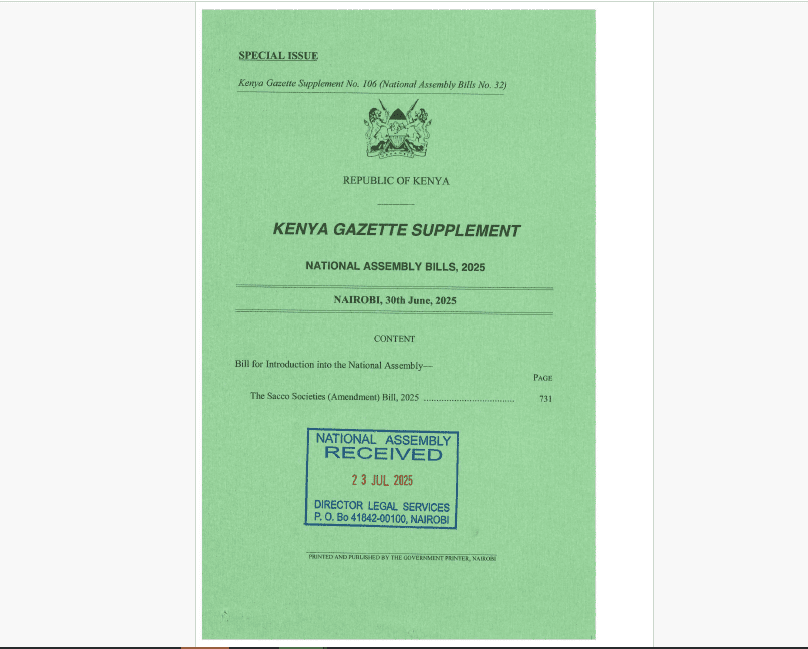
THE SACCO SOCIETIES (AMENDMENT) BILL (NATIONAL ASSEMBLY BILL No. 32 OF 2025)
(1) Background
The Sacco Societies (Amendment) Bill, 2025 was published on 30th June, 2025 and read for the first time on 1st April, 2026. The Bill has been referred to the National Assembly’s Departmental Committee on Trade, Industry and Cooperatives for public participation in accordance with the requirements of Article 118 of the Constitution. The Committee is currently receiving views from the public and stakeholders.
(2) Why is the Bill necessary?
The Bill seeks to address the challenges prevalent in the Sacco sector, including—
(a) proliferation of unregulated entities and pyramid schemes which have defrauded innocent Kenyans of their income through illegal activities;
(b) lack of effective governance structures to manage umbrella/Secondary Saccos, which has resulted in leadership wrangles, mismanagement, abuse of office and collapse of Saccos;
(c) absence of effective licensing, supervision and oversight and minimum capital requirements which has exposed Saccos and their depositors to significant risk;
(d) inability of smaller Saccos to maintain liquidity due lack of economies of scale. This has resulted in financial instability of the sector;
(e) inefficient systems for facilitating inter-Sacco payments due to weak infrastructure and platforms;
(f) lack of a legal framework to define the code of conduct for umbrella Saccos;
(g) investment of Sacco deposits in speculative, highly risky schemes and prohibited activities, which has led to loss of members’ funds;
(h) lack of a functioning Deposit Guarantee Fund to compensate Sacco members for funds lost irregularly by Sacco management; and
(i) exorbitant Sacco operational costs and poor service delivery to members.
(3) What does the Bill seek to achieve?
The Bill proposes to amend the Sacco Societies Act, Cap. 490B to modernize the regulatory framework by addressing long-standing gaps and challenges which have allowed entities handling substantial pooled Sacco funds to operate without an appropriate licensing and supervisory framework. The gaps have severely exposed member Saccos and their depositors to significant financial risk.
The Bill also seeks to operationalize the Deposit Guarantee Fund which was established in law nearly two decades ago. The Fund will finally provide the protection that was intended for members of failed Sacco societies. In particular, the Bill provides for the following—
(a) A robust regulatory framework for secondary co-operative societies to protect the interests of member Saccos and depositors.
Under the Bill, at least thirty licensed primary Saccos may voluntarily establish a Secondary Sacco to undertake central liquidity management and provide shared financial services to the member Saccos. Participation in a secondary co-operative society remains voluntary. The decision as to whether a primary Sacco joins a secondary Sacco is reserved to its members, who must approve the proposal at a general meeting in accordance with the Sacco’s by-laws and the Co-operative Societies Act, Cap. 490.
The Bill further subjects Secondary Saccos to comprehensive licensing and prudential supervision by the Sacco Societies Regulatory Authority (SASRA). A licensed Secondary Sacco will be required to maintain minimum capital adequacy and liquidity levels; comply with prudential and governance requirements; submit to both on-site and off-site inspections by SASRA; ensure that its directors and senior officers satisfy the prescribed fit and proper criteria; and submit its audited financial statements for regulatory review. To safeguard member funds and maintain the integrity of the sector, the Bill defines a code of conduct for secondary Saccos and further prohibits any person from conducting the business of a Secondary Sacco without a license.
(b) Central Liquidity and Shared Services to enhance efficiency and service delivery to depositors
The Bill provides for the establishment of a shared liquidity and payment services framework through which a Secondary Sacco may provide central liquidity management and shared financial services to its member Saccos. In this role, the Secondary Sacco will provide short-term liquidity support, facilitating inter-Sacco lending, operating shared payment infrastructure, and settling payment transactions on behalf of member Saccos. This framework will enable smaller Saccos to access a modern payment infrastructure that would otherwise be costly to establish independently, hence reducing operational costs, improving efficiency, strengthening liquidity management, and enhancing the resilience of the Sacco sector as a whole.
(c) Prohibition of certain activities to safeguard the interests of member Saccos and depositors
The Bill prohibits a Secondary Sacco from taking deposits from individuals; lending directly to individuals; engaging in wholesale or retail trade; or investing in venture capital. A Secondary Sacco will therefore be limited to providing institutional financial services to its member Sacco societies and cannot serve individual members of the public. Further, the prohibition on investment in venture capital is a deliberate prudential safeguard. The principal purpose of a Secondary Sacco is to provide liquidity management and short-term funding to member Saccos. To discharge this mandate effectively, a Secondary Sacco will be required to maintain a high level of liquidity and preserve the safety of pooled funds. The Bill therefore requires that surplus funds be invested only in secure and readily realizable assets, such as government securities, rather than speculative or high-risk investments such as venture capital.
(d) Enhanced protection of members’ deposits through the Deposit Guarantee Fund
The Bill reforms the governance and operational framework of the Deposit Guarantee Fund by restructuring its Board of Trustees; prescribing professional qualifications for trustees; introducing independence requirements; and clarifying the process for payment of protected deposits where a Sacco’s licence is revoked.
The Bill further provides that, upon the revocation of a Sacco society’s licence, eligible claims for protected deposits shall be made with the Deposit Guarantee Fund, hence clarifying the claims process. Additionally, the Bill operationalizes the Fund and authorizes the commencement of payments to eligible depositors. These reforms are intended to enable the Deposit Guarantee Fund to fulfil the depositor protection mandate for which it was established, hence enhancing public confidence and strengthening financial stability within the Sacco sector.
(e) Strengthened resilience and stability of the Sacco sector
The Bill proposes that a licensed Secondary Sacco may, subject to compliance with the applicable requirements prescribed by the Central Bank of Kenya, participate in Kenya’s interbank market. The interbank market enables financial institutions to borrow from and lend to one another to meet short-term liquidity needs and manage day-to-day liquidity positions. Access to the interbank market will enable a licensed Secondary Sacco to obtain short-term liquidity from, and place surplus liquidity with, other participating financial institutions where permitted by law. This is expected to improve liquidity management, reduce reliance on more expensive sources of funding during periods of liquidity stress, and strengthen the resilience and stability of the Sacco sector.
(4) What are the expected overall benefits from the Bill?
The Bill is expected to—
(a) improve liquidity management across the Sacco sector, which shall ensure security of members savings and timely access to affordable credit facilities;
(b) strengthen the financial resilience and stability of Saccos to ensure that they remain a viable investment and savings option for Kenyans;
(c) reduce payment and settlement risks through a shared payment infrastructure, which shall significantly reduce administration costs for Saccos and result in an overall benefit for members;
(d) enhance regulation and supervisory oversight of Saccos by SASRA and prescribe additional punitive measures to deter and weed out criminal elements and unscrupulous entities, including pyramid schemes, that have previously misappropriated the savings of innocent Kenyans;
(e) strengthen the protection of members’ deposits through the operationalization of the Deposit Guarantee Fund. This shall ensure a soft-landing for members in the unlikely event of the failure of a Sacco;
(f) enhance innovation, efficiency and financial inclusion through the use of technology, which shall attract additional members and contribute to the entrenchment of a savings culture; and
(g) promote a more efficient, resilient, and vibrant Sacco sector capable of providing improved financial services and competitive returns to its members.
(5) What next after public participation?
Upon conclusion of the public participation process by the National Assembly’s Departmental Committee on Trade, Industry and Cooperatives, the Committee will prepare a Report and the submissions from the public will inform any amendments by the Committee for consideration by the National Assembly, at the appropriate stage. If the Bill is passed by the National Assembly, it will be forwarded to the Senate for consideration in accordance with the Constitution.
The National Assembly encourages the public to consider the Bill on the basis of its ACTUAL provisions as explained herein and to ignore the misleading and false information circulating online with respect to the Bill.
A copy of the Sacco Societies (Amendment) Bill, 2025 is available at the National Assembly Table Office and on the Parliament Website http://www.parliament.go.ke/the-national-assembly/house-business/bills.
NJOROGE, CBS CLERK OF THE NATIONAL ASSEMBLY
9th July, 2026
“For the Welfare of Society and the Just Government of the People”