

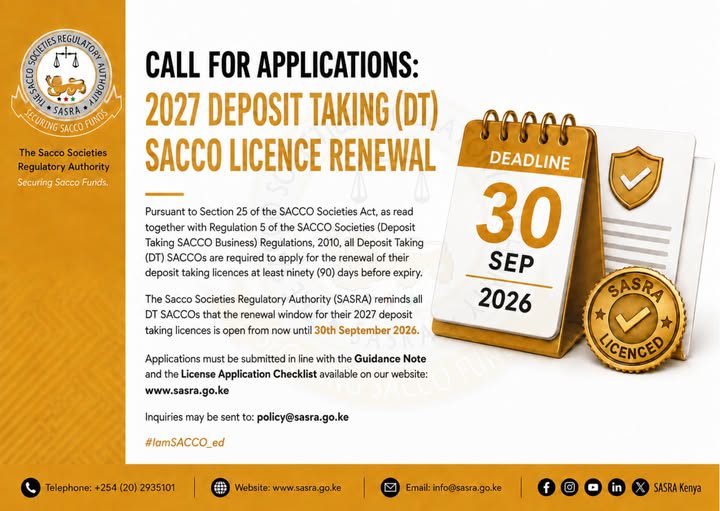
29 days left for Deposit-Taking SACCOs to renew 2027 licenses
With just 29 days remaining before the 30th September 2026 deadline, the Sacco Societies Regulatory Authority (SASRA) has called for all Saccos to submit their applications for the renewal of their 2027 deposit-taking licences.
Under the law governing SACCOs, every DT SACCO must apply to renew its deposit-taking licence at least 90 days before it expires. SASRA says the window for the 2027 licences has been open since earlier this year and closes on 30th September 2026, and it wants applications to follow the Guidance Note and Licence Application Checklist posted on its website, www.sasra.go.ke. SACCOs with questions can reach the regulator at [email protected].
The reminder is a timely prompt for members, boards and the wider public to understand exactly why doing business with a SASRA-licensed SACCO, and not just any cooperative offering attractive dividends, matters.
What SASRA does
SASRA was established under the Sacco Societies Act of 2008 and began operations in 2010 as the statutory body responsible for licensing, supervising and regulating SACCO societies in Kenya. Its mandate covers both Deposit-Taking SACCOs (DTS), which run Front Office Service Activities (FOSA) similar to bank accounts, and specified Non-Deposit-Taking SACCOs (NDTS) that meet certain thresholds. The Authority currently licenses and regulates 178 Deposit-Taking SACCOs and oversees another 177 specified Non-Deposit-Taking SACCOs, working toward its stated goal of “a financially inclusive, member-centric and stable SACCO industry.”
Why the SASRA register matters to you
- It separates lawful SACCOs from unlicensed ones. SASRA has repeatedly warned that operating a deposit-taking SACCO business without a valid licence is unlawful. Every year the Authority publishes an official list of licensed and authorised SACCO societies, and members of the public are encouraged to check this list before saving with, or borrowing from, any cooperative. A SACCO’s absence from the register is a red flag.
- It subjects your SACCO to ongoing prudential supervision. Licensing is not a one-off event, it is renewed annually and tied to compliance checks covering capital adequacy, governance, and the “fit and proper” status of board members and senior management. SASRA also requires regulated SACCOs to submit audited financial statements on strict deadlines, and has tightened oversight of the external auditors who sign off on those accounts. This continuous scrutiny is designed to catch financial distress early, rather than after members’ savings are gone.
- Deposit protection is moving from a promise to a mandate. Regulated deposit-taking SACCOs collectively held over Sh832 billion across nearly 19 million deposit accounts as of December 2025, the vast majority of them modest balances belonging to ordinary savers. Parliament is currently considering the Sacco Societies (Amendment) Bill, 2025, which would create a Deposit Guarantee Fund, modelled on the protection bank depositors already enjoy through the Kenya Deposit Insurance Corporation, to compensate members if a licensed SACCO collapses. Crucially, only deposits held in licensed, SASRA-regulated SACCOs stand to benefit from this kind of protection; savings parked in unregulated outfits carry no such safety net.
- Licensing enforces governance and transparency. Regulated SACCOs must undergo regular audits, submit periodic returns, and answer to SASRA’s supervisory checks. Non-compliance can trigger penalties, restricted licences limiting a SACCO to credit-only business, suspension, or revocation altogether: sanctions that exist precisely to protect members’ money before problems escalate.
- It signals long-term reliability. For a SACCO, successfully renewing its licence each year is a visible, verifiable marker of sound governance and financial health. For a member, choosing a SACCO on the current SASRA register is the single most effective way to safeguard savings and access to credit through the cooperative movement.