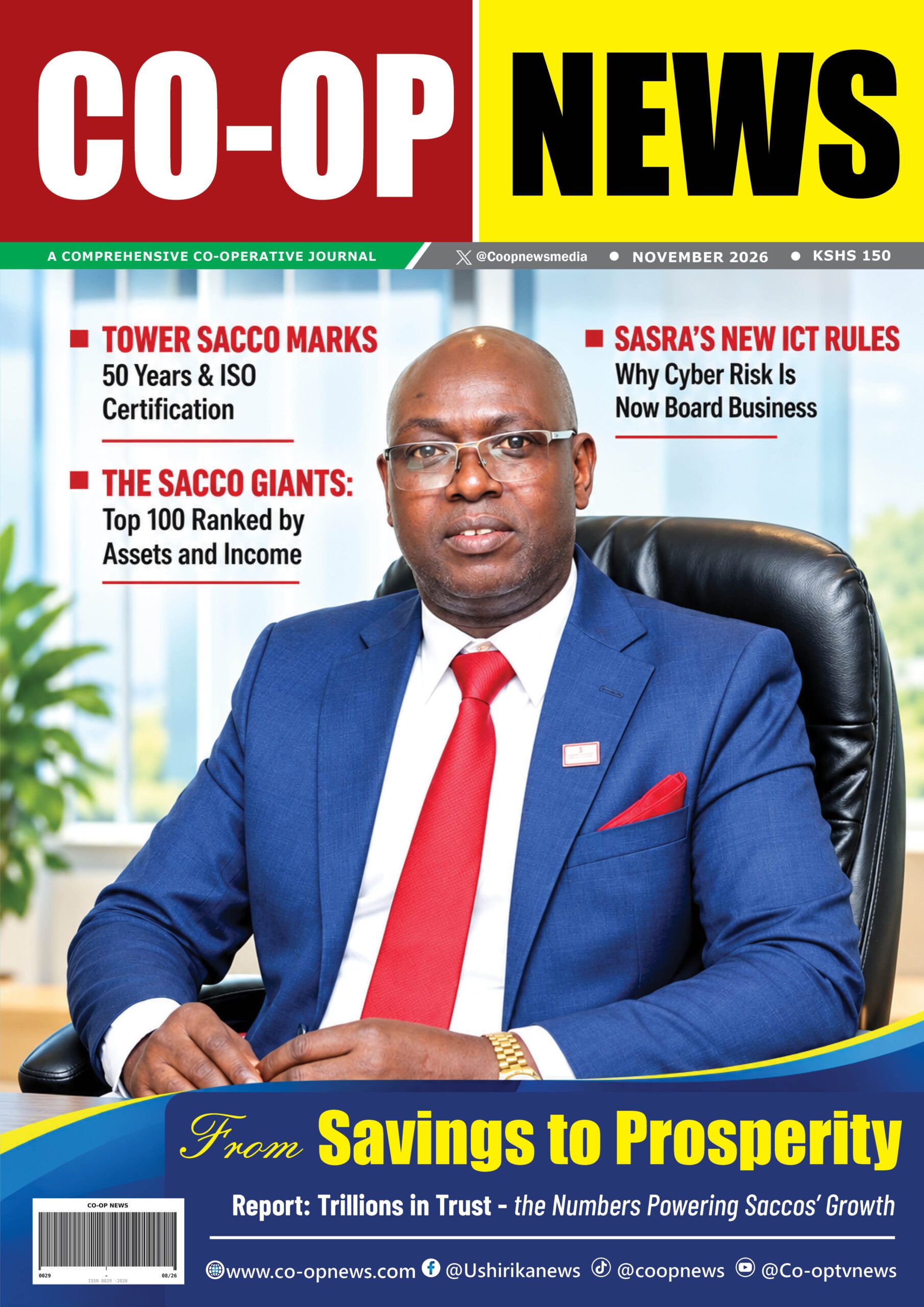


Regulated Sacco sector expanded its asset base by 12.5 per cent to Sh1.21 trillion in 2025, while the proportion of non-performing loans fell, signaling improved loan-book quality, according to the Sacco Supervision Annual Report 2025.
The sector’s total assets rose from Sh1.08 trillion in 2024, while membership increased to 7.87 million from 7.39 million. The sector’s contribution to nominal gross domestic product remained unchanged at 6.63 per cent.
The Sacco Societies Regulatory Authority (SASRA) Board Chairman Jack Ranguma said the growth reflected sustained confidence in regulated Saccos as key players in the country’s financial services sector.
“This steady growth demonstrates the enduring confidence that Kenyans continue to place in regulated Saccos as part and parcel of the domestic financial service providers,” Ranguma said.
He said the sector’s contribution to GDP remained stable in line with growth in nominal GDP, adding that regulated Saccos had maintained stability in capital, liquidity and asset quality.
SASRA Chief Executive Officer David Sandagi said the industry recorded strong financial performance, with sustained growth across key indicators.
“The financial performance of regulated Saccos remained robust, with all key performance indicators recording sustained growth,” Sandagi said.
Deposit-taking (DT) Saccos accounted for the bulk of the sector’s assets, which reached KSh1.07 trillion, while non-withdrawable deposit-taking (NWDT) Saccos expanded their asset base to KSh141.36 billion.
Bad loans decline
The quality of Sacco loan books improved during the year, with the ratio of non-performing loans (NPLs) to gross loans falling to 6.37 per cent from 8.39 per cent in 2024.
Ranguma said regulated Saccos had recorded a significant improvement in loan-book quality.
The NPL ratio for DT-Saccos declined to 6.36 per cent from 8.56 per cent, while that of NWDT-Saccos fell to 6.44 per cent from 7.07 per cent. Both ratios, however, remained above the 5 per cent benchmark set for each segment in the report.
Loans performing according to contract accounted for 88.41 per cent of gross loans, up from 86.71 per cent in 2024.
Meanwhile, loans classified as losses, those overdue by more than 360 days, declined to KSh27.88 billion from KSh38.76 billion. The report attributed the reduction to stronger loan recovery mechanisms.
The Sacco sector’s NPL ratio remained below those of commercial banks, at 15.56 per cent, and microfinance banks, at 34 per cent, in 2025.
Gross loans grew by 12.25 per cent to KSh948.67 billion, while net loans stood at KSh887.67 billion, equivalent to 73.32 per cent of total assets.
Total deposits increased to KSh832.80 billion from KSh749.43 billion in 2024. Deposit accounts also rose to 18.95 million from 16.05 million, suggesting that the average member held two or more accounts.
Accounts with balances below KSh50,000 accounted for 89.03 per cent of all deposit accounts. However, accounts holding more than Sh1 million had KSh319.66 billion, representing 38.38 per cent of total deposits.
The core capital-to-total-assets ratio for DT-Saccos improved to 19.53 per cent from 17.28 per cent in 2024.
Land and housing lead lending
Regulated Saccos disbursed KSh596.54 billion in loans across eight economic sectors in 2025, Sandagi said.
Land and housing attracted the largest share, receiving KSh157.20 billion, or 26.35 per cent of total lending. Education followed with KSh124.51 billion, while agriculture received KSh110.74 billion. Human health attracted the least funding, at KSh14.65 billion.
Agriculture’s share of Sacco lending declined to 18.56 per cent from 20.05 per cent in 2024, although the amount advanced to the sector increased.
The report linked the decline in agriculture’s share to slower growth in the sector, which expanded by 3.1 per cent in 2025, compared with 4.4 per cent in 2024.
Saccos also increased their investments in financial instruments, with holdings rising to KSh99.81 billion from KSh61.21 billion. These investments accounted for 8.24 per cent of total assets, up from 5.69 per cent a year earlier.
Unremitted deductions rise
The report raised concerns over employers who deduct Sacco contributions from employees’ salaries but fail to remit the money to the respective institutions.
Unremitted deductions increased to KSh3.92 billion in 2025 from KSh3.49 billion in 2024, affecting 89 SACCOs and 104,331 members.
County governments and assemblies accounted for the largest share of the outstanding funds, owing KSh1.88 billion, equivalent to 48.09 per cent of the total. Public universities and tertiary colleges accounted for 18.52 per cent, while state corporations contributed 12.26 per cent.
SASRA warned that delayed remittances undermine Sacco liquidity and constrain their ability to extend loans. The Authority urged employers to transfer deducted funds promptly.
The report also highlighted emerging opportunities in housing finance. An October 2025 study on Saccos and affordable housing, conducted in collaboration with the Kenya Mortgage Refinance Company and Financial Sector Deepening Kenya, found that traditional mortgages remain a relatively new product for Saccos, although uptake is gradually increasing.
Ranguma said he was encouraged by the growing inclusion of the sector’s financial soundness indicators in Kenya’s monetary and financial statistics.
He said the development underscored the critical role Saccos play in the national economy.