

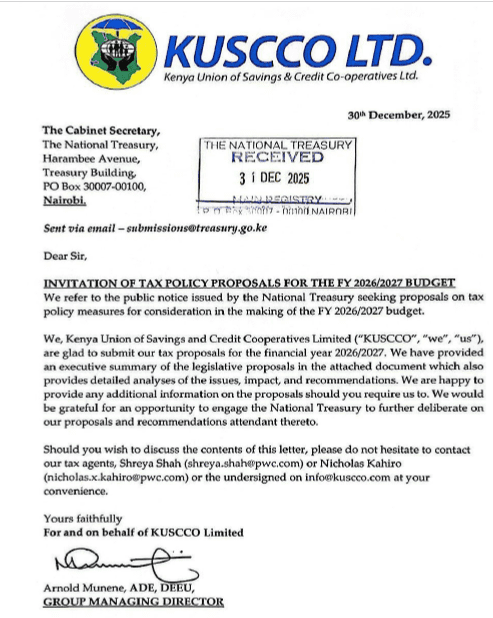
As the National Treasury prepares the FY 2026/2027 budget, the Kenya Union of Savings and Credit Co-operatives (KUSCCO) has issued a forceful set of tax policy proposals aimed at correcting what it calls “punitive” and “inequitable” tax treatments that threaten the financial backbone of millions of Kenyans.
In a detailed submission signed by Group Managing Director Arnold Munene, the union argues that current tax laws are out of sync with the realities of the cooperative movement, effectively penalizing SACCOs for being inclusive and driving up the cost of credit for the country’s most vulnerable earners.
Here are the major issues KUSCCO is urging the government to address:
- The ‘Identity Crisis’ in SACCO Membership
The most significant hurdle identified is a legal contradiction between the Co-operative Societies Act and the Income Tax Act (ITA). While cooperative laws allow SACCOs to admit groups (such as chamas and self-help groups) and corporate entities as members, the Income Tax Act narrowly defines a “primary cooperative society” as one consisting only of individual persons.
The Consequence: If a SACCO admits even a single self-help group to promote financial inclusion, it risks losing its status as a “primary” society. This results in a massive tax hike: member interest income—normally exempt—becomes taxable, and the SACCO is moved to a less favorable tax regime.
KUSCCO is calling for the definition of “designated primary cooperative societies” to be expanded to include groups and corporate persons. “This discrepancy creates punitive tax consequences for SACCOs… resulting in inequitable treatment and discouraging innovative cooperative models,” the report states.
- Ending the ‘Tax on Mutuality’ (Excise Duty)
KUSCCO is demanding an amendment to the Excise Duty Act to exclude fees charged by SACCOs to their members from the 20% excise duty currently levied on financial services.
The union’s argument rests on the “Doctrine of Mutuality”—the principle that a person cannot make a profit from themselves. Since SACCOs are member-owned, the fees paid for loan processing or account maintenance are internal contributions to a shared pool, not a transaction with an external profit-seeking entity.
“Imposing excise duty on intra-member fees fractures the identity between contributors and beneficiaries,” KUSCCO argues. The union points out that this tax directly contradicts the government’s Bottom-Up Economic Transformation Agenda (BETA) by raising the cost of loans for school fees, agriculture, and small businesses.
- Addressing the ‘Disposable Income Squeeze’
Beyond SACCO-specific taxes, KUSCCO is championing the plight of the individual Kenyan worker. The report highlights a “rigid” income tax structure that has failed to account for inflation and the recent wave of mandatory deductions.
KUSCCO notes that while nominal wages have risen, real earnings fell in 2024. Disposable income has been further eroded by:
- The Affordable Housing Levy (AHL) (1.5%)
- Social Health Insurance Fund (SHIF) contributions (2.75%)
- Increased NSSF contributions.
To provide relief, KUSCCO proposes widening the tax bands and increasing the tax-free threshold. Crucially, they are calling for the top personal income tax rate to be lowered from 35% to 30%, harmonizing it with the corporate tax rate to ensure “tax neutrality” and regional competitiveness.
- Learning from Global Peers
To bolster its case, KUSCCO pointed to international best practices. The report notes that in Uganda, SACCOs are largely exempt from income tax to encourage formal savings. In India and the Philippines, tax benefits are tied to the activity (like banking or farming) rather than the membership structure, ensuring that cooperatives can grow without being penalized for their size or diversity.
With 355 regulated SACCOs serving over 7.39 million members and accounting for 6.63% of Kenya’s GDP, KUSCCO argues the current tax regime is a “transaction-level friction” that slows down the economy.
By aligning tax laws with the cooperative principle of mutuality, KUSCCO believes the government can lower the cost of living, boost grassroots investment, and ensure that the cooperative movement remains a resilient pillar of Kenya’s financial system.
“Uniform tax treatment is not only equitable but also economically strategic,” the report notes, “reinforcing SACCOs as catalysts for inclusive growth.”