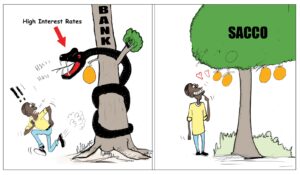


Every year around Annual General Meeting season, a familiar headline appears across Kenya: “Sacco declares record dividends and rebates.” Members celebrate — and rightly so. After all, the promise of the cooperative movement has always been simple and powerful: members own the institution, and members share the returns.
Yet beneath the applause, a quiet question is increasingly being asked — why are members celebrating high rebates while at the same time paying expensive loan interest?
This is the modern SACCO balancing act.
Understanding the Cooperative Promise
A SACCO is not a bank. A bank exists to maximize profit for shareholders who may never walk into a branch. A SACCO exists to maximize member welfare. The same person is the depositor, borrower, and owner.
In a Sacco, the loan interest you pay does not disappear into an external investor’s pocket. It returns to the same community through dividends on shares and interest on deposits.
That is why, historically, SACCOs have been the backbone of Kenya’s middle class: teachers built homes, civil servants educated children, and small entrepreneurs grew businesses because SACCO credit was predictable, accessible, and affordable.
But something subtle has changed.

The New Reality: High Rebates, High Interest
Over the past few years, many SACCOs have proudly declared double-digit returns — 15%, 17%, even above 20% combined dividends and rebates. However, many of those same SACCOs are lending at 12%–18% reducing balance (or its equivalent on a flat-rate structure).
To a member, this creates a paradox:
- As a borrower, you feel the loan is expensive.
- As a depositor, you celebrate the payout.
The two are connected. High rebates are often funded by high lending margins. This is the cooperative dilemma: a SACCO can appear successful financially while members quietly struggle with the cost of credit.
Why SACCO Loan Pricing Is Rising
The pressure is not always intentional. SACCOs themselves are under strain.
First, the cost of funds has gone up. Members now demand competitive returns because treasury bills, money market funds, and digital investments are offering attractive returns. To keep deposits, SACCOs must pay more, and higher deposit returns naturally push lending rates upward.
Second, regulatory requirements have tightened. SASRA capital adequacy rules now require SACCOs to hold stronger institutional capital and loan loss provisions. Prudence is necessary, but it is not free. The cost is built into the loan price.
Third, loan defaults have increased in a difficult economy. When non-performing loans rise, performing borrowers effectively subsidize the losses through higher interest margins.
So, the SACCO board faces a difficult equation: Lower interest rates and risk low dividends or maintain dividends and accept expensive credit.
The Real Question: What Is a SACCO For? This is where the sector must pause and reflect.
A SACCO is not primarily an investment club. It is a financial empowerment institution.
The cooperative ideal was never to deliver the highest return on deposits. It was to deliver the lowest sustainable cost of credit.
Dividends and interest are benefits, but affordable credit is the purpose.
If members cannot comfortably borrow to build a home, educate a child, or stabilize a business, then high returns become cosmetic success masking declining social impact. In fact, a SACCO paying extremely high returns should provoke not only excitement, but also examination. It may indicate excellent efficiency — or it may signal expensive borrowing within the same membership.
Rethinking Performance Metrics
Perhaps SACCO’s success should no longer be measured by dividend percentage alone.
A healthier set of questions would be:
- What is the effective cost of borrowing to a member?
- How quickly are loans processed?
- How many members are accessing credit?
- Are members becoming financially stronger year after year?
In other words, member prosperity, not institutional profit, should be the scorecard.
The Way Forward
The future of the SACCO sector lies in balance — not extremes.
SACCOs must:
- price loans fairly,
- manage operational costs aggressively,
- embrace digital efficiency,
- strengthen credit appraisal to reduce defaults,
- and educate members on sustainable expectations.
Members also have a responsibility. A cooperative cannot demand both the lowest loan rates and the highest dividends indefinitely. One comes from the other.
The conversation the sector now needs is honest transparency: members should clearly understand that rebates and dividends are not free rewards — they are redistributions of the same financial ecosystem they participate in.
A Cooperative Truth
A SACCO does not create money; it circulates it within a community.
When well balanced, everyone wins: borrowers access affordable credit, savers earn reasonable returns, and the institution remains stable across generations.
But when an imbalance occurs, the cooperative risks becoming what it was designed to replace — a financial institution that looks successful on paper while its members quietly carry the burden.
The real achievement for SACCOs in the coming decade will not be record dividends.
It will be this: a member who can borrow without fear — and repay without distress.
The writer, CPA Joseph Njoroge, is the CEO of Qona DT Sacco.