

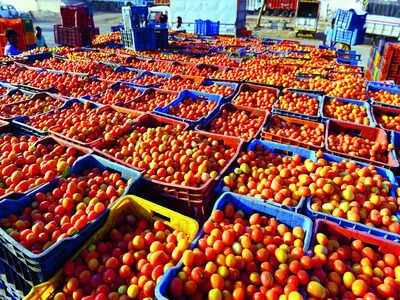
Tomato farmers in Central Kenya, particularly in Kirinyaga, Nyeri, and Laikipia counties, are suffering significant losses due to a surge in production that has flooded local markets and driven prices to historic lows.
At Kagio Market, one of the region’s largest fresh produce hubs, a 60-kilogram crate of Grade One tomatoes is currently retailing for about Sh1,000, down sharply from the usual Sh4,500–Sh6,000. Prices for Grade Two tomatoes have fallen even further, with a similarly sized crate selling for as little as Sh500.
Farmers say the glut has made it difficult for them to recover production costs amid already harsh economic conditions. Many report that the high costs of certified seeds, labor, pesticides, and irrigation have rendered the current prices unsustainable, wiping out expected profits despite favorable yields.
In Kirinyaga’s PI area, farmers note that farm-gate prices for Grade One tomatoes have dropped to between Sh300 and Sh500 per 60kg crate, forcing some to feed part of their harvest to livestock since transporting the produce to markets would only deepen their losses. They also report that buyers visiting farms are offering extremely low prices, taking advantage of the oversupply.
Post-harvest losses have risen sharply, with large quantities of tomatoes rotting in farms and markets. A walk through major markets reveals crates of unsold tomatoes deteriorating due to a lack of buyers and storage facilities.
In Murang’a County, farmers who rely on irrigation say the situation is particularly painful, as irrigation costs significantly increase production expenses. Some growers report holding thousands of kilograms of tomatoes in storage with little prospect of sale, while transport and labor costs continue to mount.
The price collapse is also evident at the retail level. At Mukuyu Market in Murang’a, tomatoes are selling for as low as Sh20 per kilogram, compared to about Sh80 before the festive season just weeks ago.
According to Ministry of Agriculture statistics, Central Kenya produces an average of 150,000 tonnes of tomatoes annually, with peak harvesting occurring between December and January. The current warm weather, which favors tomato production, is expected to exacerbate the oversupply in the coming weeks.
Agricultural experts have urged farmers to adopt cooperative marketing, value addition, and off-season production as strategies to cushion themselves against recurring market shocks. They have also emphasized the need to explore processing options such as tomato paste and sauces to reduce post-harvest losses.
Experts say the ongoing crisis underscores the urgent need for improved market linkages, processing capacity, and storage infrastructure, warning that without these interventions, farmers will continue to incur losses season after season.