

From its inception, the cooperative movement has been characterized by a distinctive approach to benefit-seeking that sets it apart from other forms of enterprise. Primarily, cooperatives facilitate access to services or markets for individuals who would otherwise be disadvantaged or excluded.
In various countries, economic and social development over recent decades—also supported by a vibrant cooperative movement—has contributed to alleviating some of the factors that previously led to exclusion and disadvantage, particularly affecting the most marginalized and underserved communities. However, the role of the cooperative model in addressing the opportunity gap that disadvantages vulnerable citizens is less central. Instead, the function of cooperation as an economic actor promoting social cohesion within the community becomes more important.
A report by the International Cooperative Entrepreneurship Think Tank (ICETT) demonstrates the unique contributions that cooperatives make to improving the well-being of members and communities. ICETT, a network of cooperatives and cooperative groups under the International Cooperative Alliance, is dedicated to strengthening the entrepreneurial performance of cooperative enterprises through innovation, research, education, and collaboration.
The ICETT survey titled “Cooperatives and Their Members: The Opportunities and Benefits of Collective Ownership” engaged 10 ICETT members from various sectors and regions, representing a total of 64 million members worldwide. The findings highlighted both direct and indirect benefits of cooperatives.
In terms of direct benefits, many of the surveyed cooperatives offer financial advantages, including discounts on products or services linked to the organization’s annual financial performance, such as patronage refunds and the redistribution of dividends. Besides, many ICETT organizations provide specialized services exclusively for their members, including medical coverage, health insurance, and various other forms of insurance, such as life and auto insurance. All ICETT organizations interviewed extend a range of non-financial benefits, which may include access to support and management services, retail assistance, operational and marketing support, and opportunities for peer networking.
To illustrate these direct benefits, ICETT highlighted the CIC Insurance Group, a prominent Kenyan insurance and financial services provider focused on cooperatives. CIC offers a range of services across East Africa, including general insurance, life insurance, and asset management. With over 20,000 shareholders, including cooperative societies and individual investors, members receive share certificates, preferential rates, and discounts on insurance products such as medical, motor, fire, and liability coverage. These financial benefits are further enhanced by CIC’s patronage dividends, which are distributed based on the cooperative’s profits. Members of CIC also gain access to Co-opCare, a medical benefits program offering subsidized rates for cooperative members.
Governance rights are a significant aspect of membership; each member has voting rights, allowing them to elect directors, influence bylaw changes, and determine the cooperative’s surplus distribution. This inclusive governance structure, based on a delegate system, ensures that each delegate has an equal vote, promoting transparency and collective influence over decision-making.
In addition to these financial advantages, CIC’s membership structure promotes community-driven values. Through participatory governance, members can actively shape the cooperative’s future, enabling it to evolve according to their collective needs.
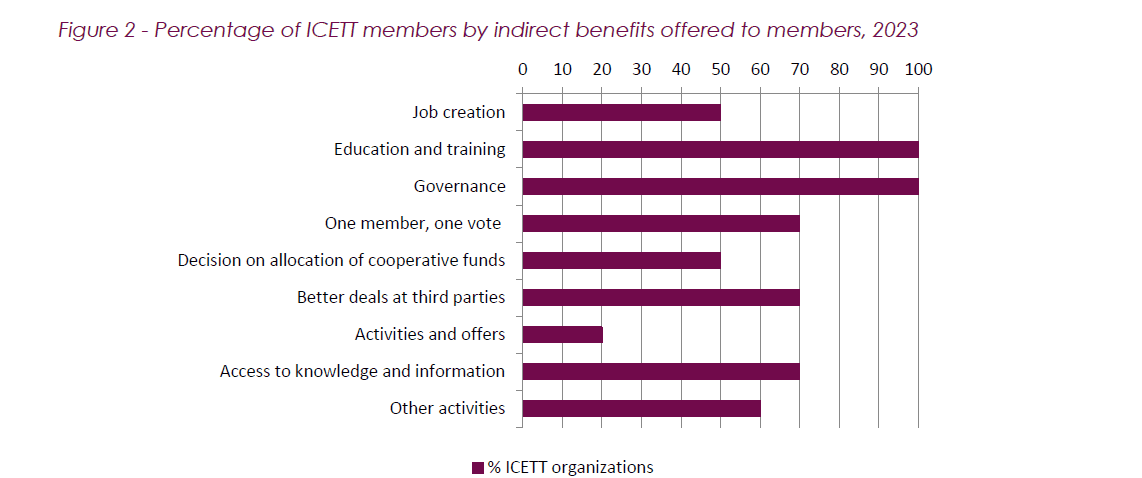
The indirect benefits associated with cooperative membership are also significant, promoting personal development, active participation in governance, and community involvement. An example is the Smart Cooperative (Smart Co-op), an initiative that offers voluntary insurance to its self-employed members by pooling risks and benefits without seeking to make a profit. Founded in Belgium in 1998, the cooperative was initially intended only for freelance artists, but its membership has since been extended to all sectors. It is now active in 40 towns and cities across 9 EU member states: Belgium, France, Italy, Spain, Germany, Austria, the Netherlands, Sweden, and Hungary.
The report also highlighted that all ICETT organizations responding to the survey prioritize the education and training of their members, providing programs aimed at enhancing both higher education attainment and talent development within the cooperative framework. Members have the opportunity to elect representatives to boards and councils, which is a fundamental aspect of cooperative governance.
Cooperatives play a crucial role in promoting socio-economic development within local communities. All respondents in the survey reported that they actively engage in local networks, strengthening connections and supporting community development. They also redistribute a portion of their profits back into the community, which helps fund local projects and initiatives, further driving community growth and well-being.
The survey indicates that the cooperative model must evolve to meet the increasing demand for social cohesion and solidarity. Cooperatives have the potential to cultivate a sense of purpose and shared vision in a social context where these values may have eroded or been lost.
The ICETT survey examines the changing nature of the benefits sought by cooperative members. It reveals a shift from a focus on individual economic benefits—such as access to goods or easier credit—to collective benefits that positively impact the broader community and society. This transformation is driven by changing societal values, particularly among younger generations who prioritize non-material well-being, as well as a decline in social cohesion.
The survey also emphasizes the need for cooperatives to differentiate themselves from other businesses clearly. Cooperatives should plan, monitor, and communicate their unique value propositions to both their members and the wider public. Moreover, cooperatives must embed themselves within their communities by engaging in collaborative, long-term projects instead of merely participating in superficial corporate social responsibility (CSR) activities.