
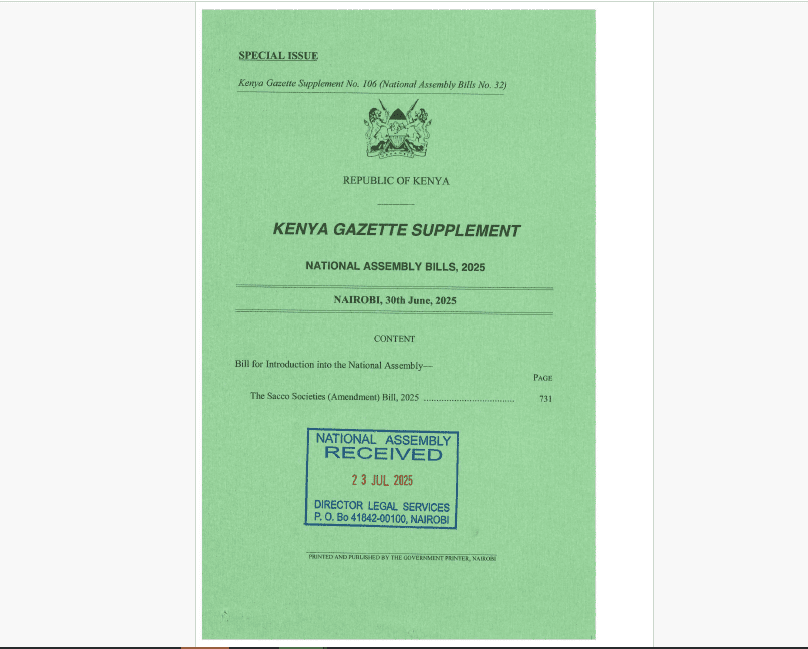
The National Assembly published a detailed public explainer defending the Sacco Societies (Amendment) Bill, 2025, urging Kenyans to judge the proposed law on its actual text rather than what it called misleading information circulating online.
The notice, published as an advertiser’s announcement in a local daily and signed by Clerk of the National Assembly S. Njoroge, laid out for the first time in one document why lawmakers say the reforms are needed, what the Bill does and does not do, and what stage the legislation has reached.
According to the explainer, the Bill was published on 30 June 2025 and had its First Reading in the National Assembly on 1 April 2026, a gap of roughly nine months that Parliament has previously cited to counter claims the legislation was being rushed through. It is currently before the National Assembly’s Departmental Committee on Trade, Industry and Cooperatives, which is collecting public and stakeholder views under Article 118 of the Constitution.
Once that process concludes, the Committee will produce a report and recommend any amendments before the Bill returns to the House for further debate. If passed by the National Assembly, it will proceed to the Senate, in line with constitutional requirements for legislation touching on cooperative societies, a devolved function.
The explainer sets out nine specific failures in the sector that the reforms are meant to fix:
- Unregulated entities and pyramid schemes that have defrauded savers
- Weak governance in umbrella or “secondary” Saccos that has produced leadership disputes and collapses
- The absence of licensing, supervisory and minimum capital rules
- Small Saccos’ inability to maintain adequate liquidity
- Inefficient inter-Sacco payment systems
- The lack of a legal code of conduct for umbrella Saccos
- The investment of member deposits in speculative or prohibited schemes
- A Deposit Guarantee Fund that has never made a payout since being established in law nearly two decades ago
- High operational costs paired with poor service to members
What the Bill would create
Central to the proposal is a new category of institution, the secondary Sacco, which at least thirty licensed primary Saccos may voluntarily come together to form. Parliament was explicit that joining one is not compulsory: any decision by a primary Sacco to become a member is reserved to that Sacco’s own members, who must approve the move at a general meeting under the Sacco’s by-laws and the Co-operative Societies Act.
Once formed, a secondary Sacco would be subject to full licensing and prudential supervision by the Sacco Societies Regulatory Authority (SASRA), including minimum capital and liquidity requirements, governance rules, on-site and off-site inspections, vetting of directors and senior officers against a “fit and proper” standard, and mandatory submission of audited accounts. Operating such a business without a license would be prohibited outright.
The National Assembly noted that secondary Saccos would be barred from taking deposits or lending directly to individuals, from engaging in wholesale or retail trade, and from investing in venture capital. Parliament framed the venture-capital ban specifically as a prudential safeguard, arguing that an institution whose core purpose is managing pooled liquidity must keep surplus funds in safe, readily realizable assets such as government securities rather than speculative investments.
Their core function would be providing short-term liquidity support and shared services to member Saccos, including a shared payment platform, settlement of inter-Sacco transactions, and, subject to Central Bank of Kenya requirements, access to the interbank market to manage liquidity shocks more cheaply than through informal funding sources.
DGF reforms
A second strand of the Bill reforms the Deposit Guarantee Fund, which Parliament said has existed on paper for close to twenty years without functioning as intended. The changes would restructure the Fund’s Board of Trustees, introduce professional qualification and independence requirements for trustees, and set out a clearer process for members to claim protected deposits once a Sacco’s license is revoked. The reforms are designed to give members a “soft landing” in the event a Sacco fails.
The National Assembly directly appeals to the public to assess the Bill “on the basis of its ACTUAL provisions” and to disregard what it called false and misleading information circulating online. The statement followed weeks of public anxiety over the legislation, some of it fuelled by unrelated government remarks about tapping cooperative sector savings for infrastructure financing.
Parliament said copies of the Bill are available at the National Assembly’s Table Office and on the parliamentary website, and that the public participation window remains open for Kenyans wishing to submit views before the Committee finalizes its report.