
“How to resolve credibility problem for your business?
You may deliver better work than the company that just won the tender. The buyer never knew, because nothing credible said so.
Consider a question most business leaders avoid: if a serious buyer researched your company today, what would they find? Not your product, your reputation.
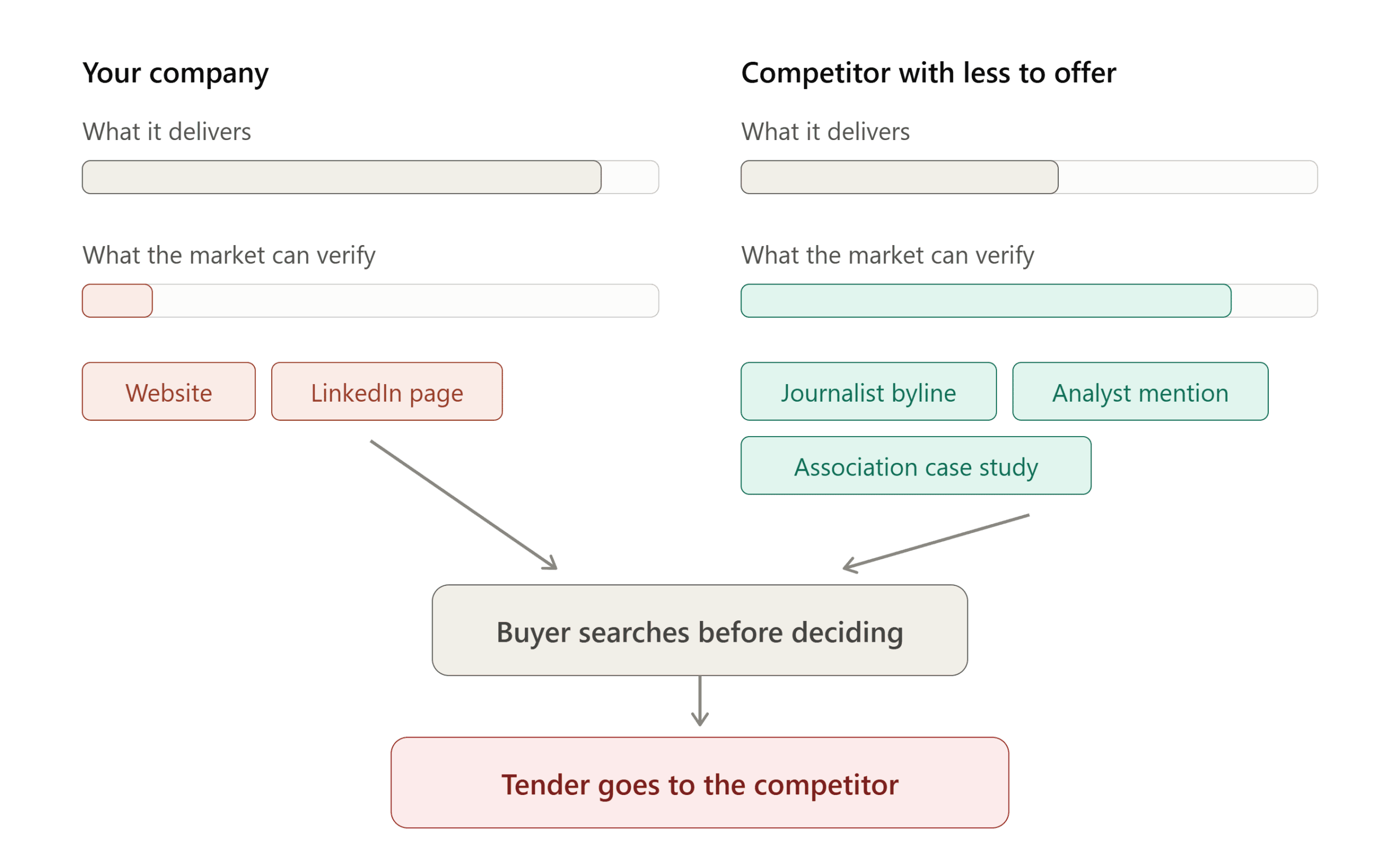
For most Kenyan businesses, the honest answer is very little. A website. A LinkedIn page. Nothing written about the company by anyone who doesn’t work there.
That gap between what a business delivers and what the market can verify is not a marketing problem. It is a credibility problem, and advertising cannot fix it. Credibility has to be earned, in public and over time, through third-party evidence that buyers trust precisely because the company didn’t write it. This is how reputation converts into revenue, and most Kenyan businesses have no infrastructure for it.
Being known is not being credible.
Many companies treat visibility and marketing spend as the whole job. Advertising tells the market you exist. It says little about whether you can be trusted, because buyers understand that self-praise proves nothing. HG Insights’ 2026 B2B Buying Disconnect Report found that vendor-produced marketing now ranks last among the sources B2B buyers trust. Peer conversations and independent reviews rank well ahead, and buyers seek those out themselves.
What outranks everything is third-party validation: a journalist’s byline, an analyst’s mention, an association’s case study. TrustRadius found that nearly half of B2B buyers never speak to a vendor representative before forming a decision. The research happens on search engines and review platforms you don’t control and often don’t monitor.
AI tools are increasingly the first stop in that research, and they don’t answer from your website. Muck Rack’s May 2026 study of more than 25 million citations across ChatGPT, Claude, and Gemini found that 84 percent of what these tools cite about a company comes from earned media coverage. A business with no earned media is effectively invisible to the tool a growing number of buyers consult first.
Your website can no longer vouch for you. Only something outside your business can.
Kenya’s position makes this both urgent and winnable. The 2025 Edelman Trust Barometer found that 72 percent of Kenyans trust business, against 38 percent for government. That baseline trust is a real asset, but it does not transfer automatically to any one company. It is an opening, and you fill it with evidence a procurement officer or investor can verify, not by assuming that operating in a trusted sector is enough.
Earned credibility behaves differently from a paid campaign. An article doesn’t vanish when the budget runs out, and one credible mention makes the next easier to secure, because journalists and analysts follow each other’s work. A company with three years of consistent earned coverage is not three times as credible as one with a single year. The effect is closer to exponential, because each mention becomes source material for the next.
None of this appears on a monthly sales report, which is why most finance leads never ask for it.
What skipping it costs
The cost rarely shows up as a line item. It shows up as the tender lost to a competitor with a stronger media footprint. It shows up as the investor meeting that ended politely because the diligence search came back thin. It shows up as the sales cycle that ran three months longer than it should have, because the buyer arrived unconvinced and had to be persuaded from zero.
Treat public credibility as infrastructure: build it deliberately and maintain it like any other asset. That is not spending on something soft. It closes a gap that your silence would otherwise leave open for a competitor with less to say but more discipline about saying it.

Kimani Patrick is Founder & CEO of The Carlstic Group Ltd, a Strategic Communications & PR firm based in Nairobi. Get in touch with Carlstic to strengthen your brand perception and positioning.