
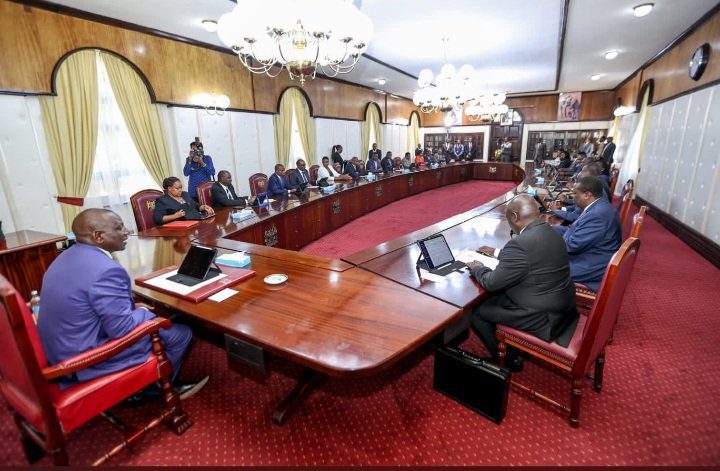
The Cabinet has approved a Ksh 4.7 trillion national budget for the 2026/27 financial year, marking a Ksh 100 billion increase over the current fiscal cycle.
According to a Cabinet dispatch released Tuesday, the government targets Ksh 3.53 trillion in revenue collection. With total expenditure projected at Ksh 4.7 trillion, the plan leaves a significant financing gap of approximately Ksh 1.17 trillion, which the state intends to bridge through strategic borrowing and alternative funding mechanisms.
Spending Breakdown
The budget remains heavily weighted toward recurrent expenditure, which is set at Ksh 3.46 trillion. In contrast, development spending has been allocated Ksh 749.5 billion, reflecting a delicate balancing act between sustaining government operations and investing in growth-oriented capital projects.
Devolution remains a central pillar of the fiscal plan, with county governments slated to receive Ksh 495.7 billion in total transfers. This includes an equitable share of Ksh 420 billion—representing 21.9 percent of the most recently audited national revenue, a figure that comfortably exceeds constitutional thresholds.
The allocation for counties further includes:
- Ksh 15.2 billion for the Equalisation Fund.
- Ksh 75.7 billion via the County Governments Additional Allocation Bill, 2026.
- Ksh 2 billion set aside for the Contingency Fund.
Economic Outlook and Strategy
The Cabinet expressed optimism regarding the country’s economic trajectory, projecting GDP growth of 5 percent in 2025 and 5.3 percent in 2026. This growth is expected to be fueled by favorable weather patterns, robust agricultural output, climate-smart investments, and the continued execution of the Bottom-Up Economic Transformation Agenda (BETA).
Officials described the 2026 Budget Policy Statement (BPS) as a strategic pivot. The administration is shifting away from the era of heavy, scaled-up infrastructure investments toward measures designed to sustain economic expansion and stabilize public finances.
Key Priorities and Reforms
The government’s primary spending focus will remain on education, health, agriculture, energy, infrastructure, social protection, and national security. To support these goals, the state plans to accelerate structural reforms in public finance management, the digitization of government services, and the management of State-owned enterprises. There will also be an increased emphasis on leveraging public-private partnerships (PPPs) to drive development.
As the fourth budget under the Kenya Kwanza administration, the Budget Policy Statement will now be tabled in Parliament to undergo legislative scrutiny and guide the nation’s fiscal policy for the 2026/27 financial year.