

Kenya’s cooperative savings sector has always run on a single tier: primary Societies, owned and governed by their individual members, taking deposits and lending back to them.
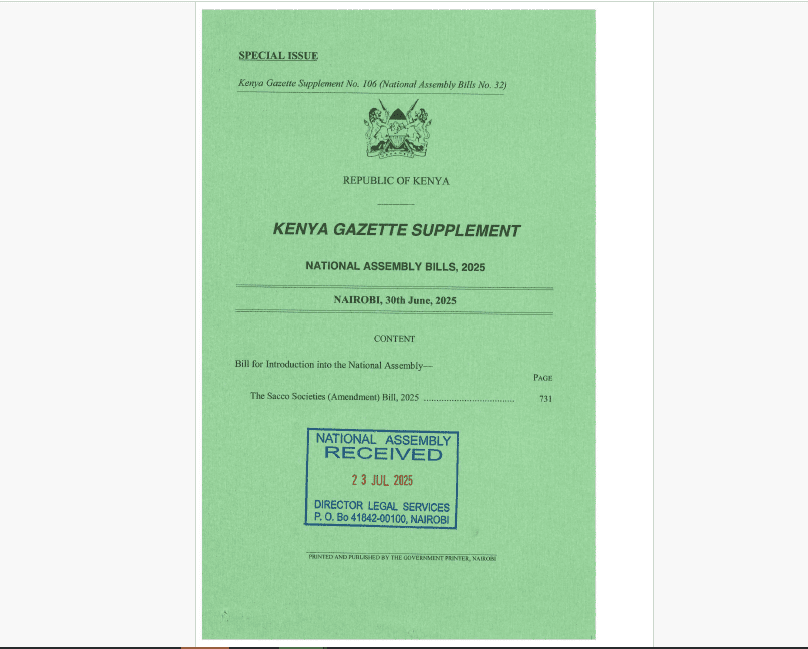
The Sacco Societies (Amendment) Bill, 2025, published as National Assembly Bill No. 32 on 30 June 2025 and sponsored by Majority Leader Kimani Ichung’wah, introduces something new to Kenyan law: a formally regulated second tier of cooperative institution, built to serve other SACCOs rather than individual savers.
The Bill’s object is to amend the Sacco Societies Act, Cap. 490B, “to provide for the establishment of secondary Sacco societies, and regulate the conduct of central liquidity and shared services business by secondary Sacco societies.” A second, related object is to operationalize the long-dormant Deposit Guarantee Fund and restructure how its trustees are appointed.
Clause 2 inserts four new definitions. A secondary co-operative society is a cooperative registered under the Co-operative Societies Act whose membership is restricted to primary SACCOs, and which carries on “central liquidity and shared services business”, receiving money from member SACCOs into a liquidity reserve account, investing and lending it, and running shared payment platforms so member SACCOs can settle transactions with each other securely. A liquidity reserve account is the operating account through which a secondary society settles members’ payment transactions, and a member Sacco is simply a deposit-taking SACCO belonging to one of these secondary bodies.
Who can form one
Under the new section 28A, at least thirty licensed or authorised SACCOs may come together to form a secondary co-operative society.
Section 28B then lists, across fifteen paragraphs, what such a body may do once formed: hold a liquidity reserve account for each member; collect minimum liquidity contributions; take deposits from member SACCOs (not individuals); invest in government securities; lend short-term to members and facilitate inter-SACCO lending; participate in the interbank market under Central Bank of Kenya rules; hold statutory liquidity reserves at the Central Bank; run a shared payments platform and issue payment instruments; offer agency services for domestic and international transfers; facilitate trade finance and performance guarantees; and submit daily reports to SASRA, among other prescribed activities.
Section 28C explains what a secondary SACCO may not do: it cannot take deposits from natural persons, cannot lend to natural persons, cannot trade wholesale or retail, and cannot invest in venture capital.
This clause directly answers online claims of a government-controlled “super SACCO” reaching into ordinary members’ pockets, by design, a secondary SACCO’s counterparties are other SACCOs, not people.
Having created the institution, the Bill gives prudential rules closer in spirit to banking regulation than to conventional cooperative law.
Mandatory licensing (section 28E) bars any cooperative from conducting this business without a SASRA license, and licensing this activity becomes an explicit object of the Authority under section 5.
A binding code of conduct (28D) must be adopted by every licensed society, on top of minimum standards SASRA sets in Regulations.
Capital and liquidity adequacy (28F) are set by the regulator, not the institution, and societies must keep a minimum share of member deposits in a Central Liquidity Fund.
Leadership faces fit-and-proper vetting (28G): governance sits with a non-executive board plus a CEO, and no one may be appointed unless SASRA approves them under criteria it will set.
SASRA gets direct supervisory powers (28H); licensing, setting capital and liquidity standards, on-site and off-site supervision, vetting management, pre-approving board appointments and auditors, and approving audited accounts, with its existing enforcement powers under sections 49–54 extended to secondary societies.
Criminal penalties (28I) attach to any contravention: a fine of up to Sh3 million, up to five years in prison, or both.
Finally, a wide regulation-making power (28J) lets SASRA later prescribe fees, capital and liquidity details, the code of conduct, penalties, and fit-and-proper criteria.
Why now
This isn’t being written in a vacuum. For years, the Kenya Union of Savings and Credit Co-operatives (KUSCCO) performed a version of this liquidity-pooling role with no dedicated licensing regime, capital rules, or ring-fencing attached. A 2025 forensic audit found roughly Sh12.6 billion belonging to 201 SASRA-regulated SACCOs sitting with KUSCCO when it hit a liquidity crisis compounded by internal fraud; money that was, in practice, commingled rather than held in traceable, member-specific accounts. The Bill’s dedicated liquidity accounts, capital rules, leadership vetting, and criminal penalties all read as direct responses to exactly the failure modes KUSCCO exposed.
DGF
Clauses 6 through 9 tackle a related problem: A Deposit Guarantee Fund that has existed in law for nearly two decades without ever making a payout. The Bill restructures its Board of Trustees, replacing the Commissioner for Cooperatives with the Principal Secretary for Sacco matters, adding the Principal Secretary to the Treasury, and introducing a presidentially-appointed non-executive chairperson with at least fifteen years’ relevant experience. Four more trustees, gender-balanced and experienced in cooperative or banking supervision, are appointed by the Cabinet Secretary, with serving SACCO officers, their associates, and recent auditors barred from sitting as trustees.
A new section 57A shields trustees and Fund officers from personal liability for good-faith acts, while a new section 59A blocks any actual payouts until the Cabinet Secretary gazettes a commencement date; so this protection isn’t automatic even once the law passes. Section 59 is also amended to let a member claim against the Fund once their SACCO’s licence is revoked, rather than waiting for full insolvency.
What’s still unsettled
Two structural points stand out from the Bill’s own Memorandum: it concerns county governments under Article 110(1)(a), since cooperatives are a devolved function, meaning Senate involvement isn’t optional, a lesson drawn from an earlier Sacco law courts nullified for bypassing the Senate, and it acknowledges it “may occasion additional expenditure of public funds.”
More substantively, the Bill leaves its real safeguards to future Regulations rather than fixing them in the Act itself: actual capital and liquidity thresholds, the detailed code of conduct, fit-and-proper criteria, and the penalty regime are all left for SASRA to prescribe later. That’s a common legislative technique, but it means the real test of whether this prevents another KUSCCO-style failure plays out in rules and supervisory practice that don’t exist yet.
Participation also remains voluntary as drafted; nothing compels a primary SACCO to join a secondary one. Whether that survives public participation and committee amendments, and how tightly SASRA sets the capital and liquidity bars, will decide whether this new tier becomes a genuine stabilizing backbone for Kenya’s Sh1.2 trillion-plus SACCO sector or simply relocates the KUSCCO problem into a better-labelled box.