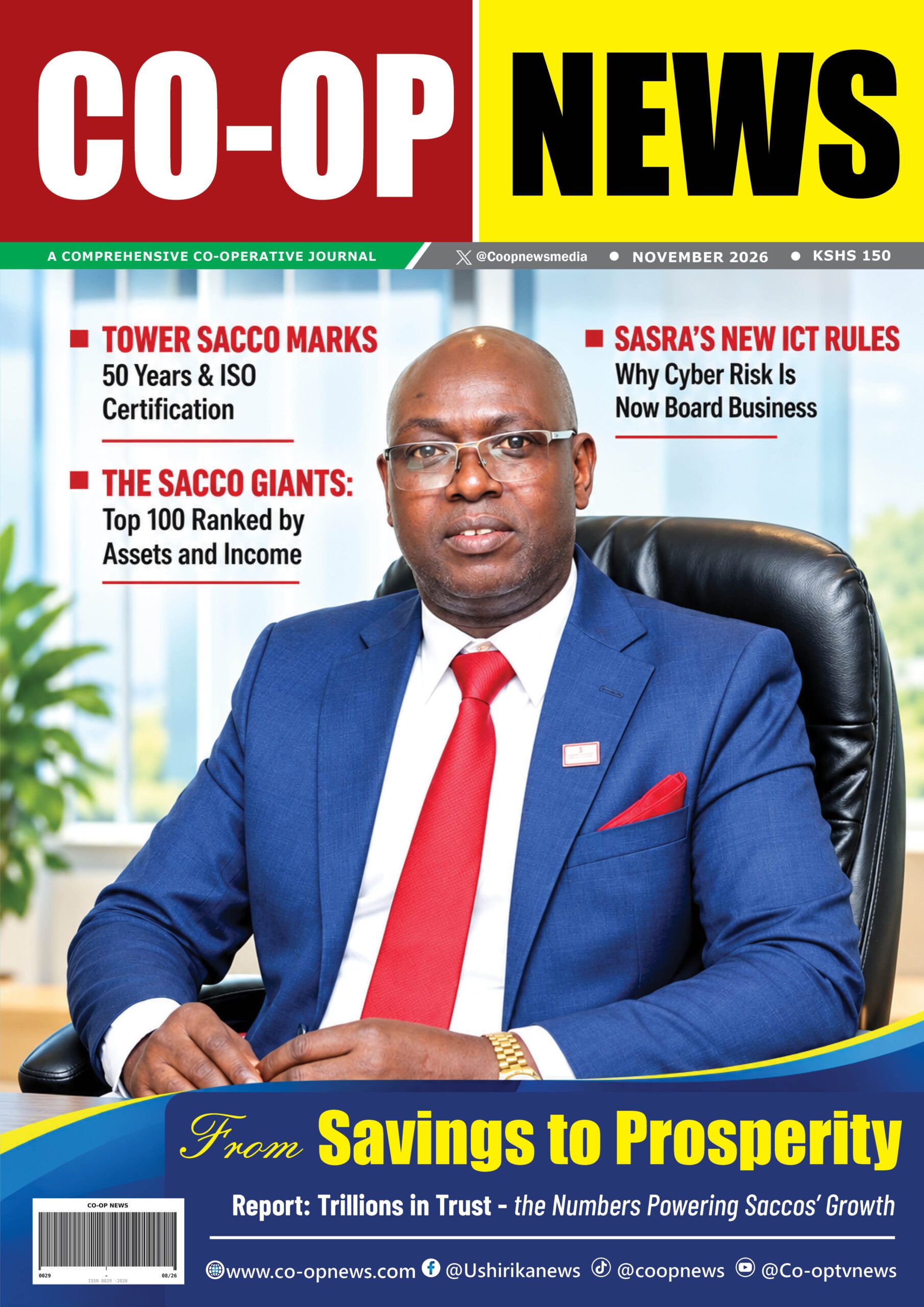


Symon Mburia, a veteran co-operative administrator with more than three decades of experience in sector management and restructuring, has assumed office as Acting Commissioner for Co-operative Development following David Obonyo’s retirement.
Mburia, who previously served as Deputy Commissioner for Co-operative Development, takes over at a time when Kenya’s co-operative movement is navigating changing regulatory demands, growing financial-sector competition and calls for stronger governance and accountability.
His appointment brings to the helm an administrator whose career has been closely tied to the restructuring, revival and development of co-operative societies across the country.
Mburia joined the public service in 1993 as a co-operative officer in the then Tharaka Nithi District. He subsequently served in Meru, Mwingi, Embu and Nairobi, gaining experience in co-operative management, institutional restructuring and community development.
Among his notable assignments was the restructuring of the banking section of Meru South Union into a rural savings and credit co-operative. He also participated in reorganising Meru Union into separate entities, including Capital Sacco, Meru Dairy, Meru Coffee Union and Meru Multipurpose Co-operative, in a move aimed at safeguarding members’ funds and placing the institutions on a more sustainable financial footing.
In Embu, Mburia was part of the team that helped revive Embu Farmers Sacco, now known as Nawiri. He also contributed to the development and promotion of diaspora co-operatives, including initiatives serving Kenyans in Atlanta, United States, and the United Kingdom.
Beyond his field assignments, Mburia has served at the national level as Assistant Commissioner for Co-operative Development. He was also seconded to the Kenya Society of Professional Co-operators (KSPC), where he served as acting chief executive, contributing to professional development within the movement.

His academic qualifications include a Bachelor of Commerce degree from the University of Nairobi, a Master of Science in Entrepreneurship from Jomo Kenyatta University of Agriculture and Technology, and a certificate in Public Policy Development from Strathmore University. He has also undertaken specialised training in multi-stakeholder processes and social learning at Wageningen University in the Netherlands, alongside rural development programmes in Israel, Thailand and Malaysia.
Mburia’s experience has also shaped his views on the direction of Kenya’s co-operative movement. While he considers the financial segment, comprising SACCOs, Co-operative Bank, CIC and KUSCCO, to have made considerable progress, he has expressed concern about the performance and sustainability of some agricultural and housing co-operatives.
One of his key concerns is the impact of widening the common bond in SACCOs, which has expanded membership but, in his assessment, also contributed to increased loan defaults. He has cautioned that some societies are increasingly relying on collateral, debt collectors and auctioneers to recover loans, practices he believes risk undermining the mutual-support principles on which the movement was founded.
In past media interviews, he has questioned the growing emphasis on high dividends, arguing that the traditional SACCO model prioritized affordable credit and member welfare over maximizing returns. Under that model, interest charged on loans was intended primarily to cover operating costs, with surpluses returned to members. He has warned that the pursuit of higher dividends could encourage expensive lending and attract investment-oriented members at the expense of the ordinary members the institutions were established to serve.
His immediate responsibilities will include providing leadership and direction to the State Department for Co-operatives as it continues to oversee the development, regulation and strengthening of the country’s co-operative institutions.
Mburia has already begun engaging key stakeholders in the movement. In a recent meeting with Co-operative Bank of Kenya, discussions reaffirmed the longstanding partnership between the bank, the Government and the wider co-operative movement through the Commissioner’s office.
Co-operative Bank, which is 64.5 per cent owned by co-operative societies, has maintained a close relationship with the movement for nearly six decades, supporting its growth through financial services, capacity building, governance initiatives and digital transformation