

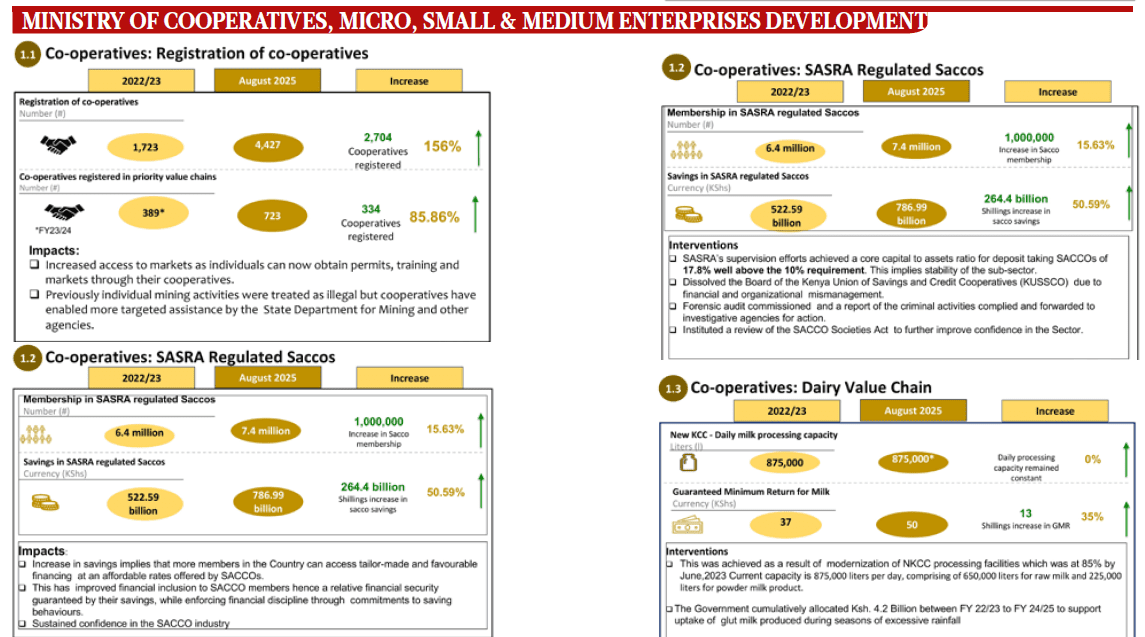
Regulated Saccos are facing a growing financial crisis, as the latest Sacco Supervision Annual Report 2024 reveals a shocking surge in non-remitted employee deductions, now standing at a whopping Ksh 3.49 billion, up from Ksh 2.59 billion in 2023.
At the heart of this crisis are delayed or withheld remittances by employer institutions, primarily County Governments, public universities, parastatals, and national government agencies. These funds, legally deducted from employee salaries to be transferred to Saccos for loan repayments and savings, are increasingly being diverted or held back, a practice now threatening the very stability of the regulated Sacco industry.
The traditional Sacco model relies heavily on a tripartite agreement: an employee instructs their employer to deduct funds for BOSA savings or loan repayments, which are then remitted to their Sacco. This model, supported by Section 35 of the Cooperative Societies Act, has long been a cornerstone of Kenya’s cooperative movement.
However, despite its strengths, such as an institutionalized savings culture and secured loan repayments, the system is now cracking under the weight of widespread non-remittance.
Who Owes the Most?
The report published by the Sacco Societies Regulatory Authority (SASRA) pinpoints County Governments and Assemblies as the worst offenders. In 2024 alone, they owed Ksh 1.61 billion, accounting for 46.07% of the total unremitted funds, nearly double the Ksh 865 million recorded in 2023.
Also on the list of habitual defaulters are:
Public Universities and Tertiary Colleges: Ksh 762.27 million (21.85%)
County-owned Public Sector Companies: Ksh 265.77 million (7.62%)
State Corporations and Parastatals: Ksh 164.76 million (4.72%)
National Government Ministries and Agencies: Ksh 129.72 million (3.72%)
These institutions, despite consistently paying their employees, are accused of diverting funds meant for Saccos to other uses, a move the Sacco regulator decries as unethical and destabilizing.
Loan Repayments Hit Hardest
Of the Ksh 3.49 billion in non-remitted funds, Ksh 2.60 billion (74.5%) was meant for loan and credit facility repayments, meaning thousands of Sacco members now appear to be in default through no fault of their own. The ripple effect? A spike in non-performing loans and a liquidity squeeze across 85 affected regulated Saccos.
The remaining Ksh 0.89 billion (25.5%) was meant for BOSA (Back Office Savings Activities) deposits, slightly down from Ksh 0.91 billion in 2023, but still significant.
However, Deposit-Taking Saccos absorbed the lion’s share of the hit, with Ksh 3.10 billion (88.75%) owed to them, up from Ksh 2.16 billion in 2023. Their open-bond nature makes them more exposed to multiple employer institutions, unlike their Non-Withdrawable Deposit-Taking (NWDT) counterparts, which recorded a reduction in exposure to Ksh 0.39 billion (11.25%).
Alarmingly, some Saccos have lost court battles over non-remitted funds due to poor record-keeping. The regulator is now urging Saccos to maintain proper documentation, including member instructions, deduction schedules, and reconciliation statements, as critical evidence for legal recovery processes.
SASRA has vowed to continue pushing for policy reforms, especially targeting government institutions. Given that cooperative functions are a devolved mandate, the continued default by counties is seen as a direct contradiction of their constitutional duty to promote cooperatives.
“The situation is unacceptable,” reads part of the report. “Employees are paid, deductions are made, but the funds are not remitted. This can only be described as a financial injustice.”
With over 55,000 Sacco members affected, the rising tide of non-remitted deductions poses an existential threat to the financial health of Saccos, institutions that have long supported grassroots savings, credit access, and economic empowerment.
If the trend is not reversed, Saccos may face mounting defaults, eroded trust, and reduced ability to serve their members, all while billions meant for them sit elsewhere, unaccounted for.