

If you’ve been looking for investment options beyond the usual bank deposits and Treasury bills, chances are you’ve come across the term “special fund.” But what exactly is it, and how does it work in Kenya’s regulated market?
A pool with a purpose
A special fund is a type of Collective Investment Scheme (CIS) — essentially, a structure where many investors combine their money under professional management toward a shared goal. What sets special funds apart from ordinary unit trusts or money market funds is their mandate: they are specifically designed to invest in non-traditional, higher-yield assets such as real estate, commodities, and derivatives.
In plain terms, a special fund is for investors who want more than what a savings account or fixed deposit can offer, and who are prepared to accept more risk in pursuit of that return.
Who runs the show?
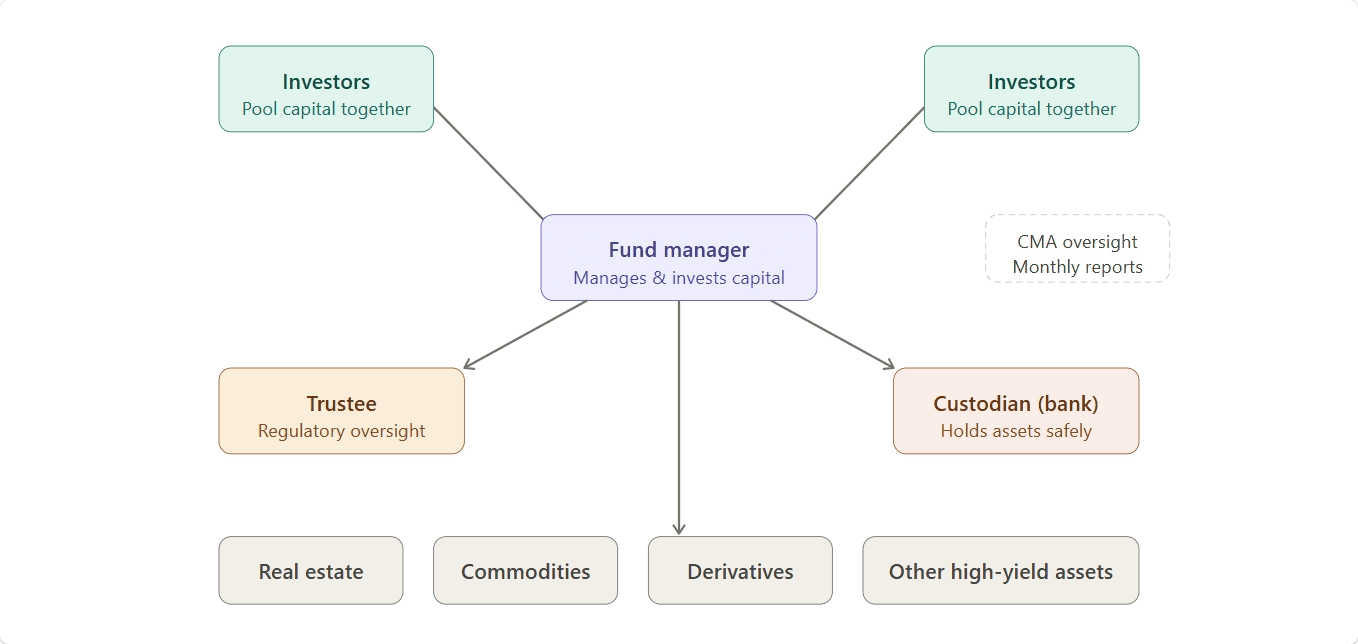
Three key parties govern every special fund in Kenya, as illustrated in the diagram above.
The fund manager is the operational heart — a licensed professional who makes the investment decisions, conducts market research, and ensures that every shilling invested is deployed according to the fund’s stated objective. The trustee acts as an independent watchdog, ensuring the fund operates within the law and that investors’ interests are never compromised. The custodian, typically a licensed bank, physically holds the fund’s assets in safekeeping.
Sitting above all three is the Capital Markets Authority (CMA), which regulates special funds under the Capital Markets Collective Investment Schemes Regulations, 2001. Fund managers are required to file monthly reports with the CMA, giving the regulator a continuous window into how investor money is being managed.
The appeal: why investors choose special funds
The most obvious draw is the potential for higher returns. By investing in sectors like real estate or commodity markets, special funds can access yields that traditional vehicles — Treasury bonds, fixed deposits, money market funds — simply cannot match. They also offer an inflation hedge and the possibility of capital appreciation over time.
Beyond returns, diversification is a significant advantage. Most retail investors would struggle to independently access derivatives or commercial real estate. A special fund pools resources to open those doors, spreading risk across a wider range of assets than any single investor could manage alone.
Professional management is the third pillar. You don’t need to understand futures contracts or property valuations yourself — the fund manager’s job is to do that work on your behalf, backed by research and risk management processes.
The risks you must understand
High returns never come without high risk, and special funds are no exception.
Liquidity risk is perhaps the most important to grasp. Assets like real estate cannot be quickly converted to cash. If many investors want to exit at the same time, the fund may not be able to accommodate them immediately. Credit risk arises when borrowers or counterparties default. Foreign exchange risk comes into play when the fund holds international assets, and interest rate movements can affect the value of certain securities.
The CMA’s oversight and the trustee’s watchdog role provide important safeguards, but they do not eliminate risk — they manage it.
The bottom line
Special funds are a legitimate, regulated investment vehicle suited to investors who seek portfolio diversification, are comfortable with a moderate-to-high risk profile, and have a medium-to-long-term investment horizon. They are not a place to park money you may need at short notice.
Before investing, read the fund’s prospectus carefully. Understand what assets it holds, how returns are distributed, and what the exit process looks like. Align the fund’s objective with your own financial goals — and if in doubt, consult a licensed financial advisor. The CMA’s public register is a good starting point to verify that any fund you are considering is properly licensed.