

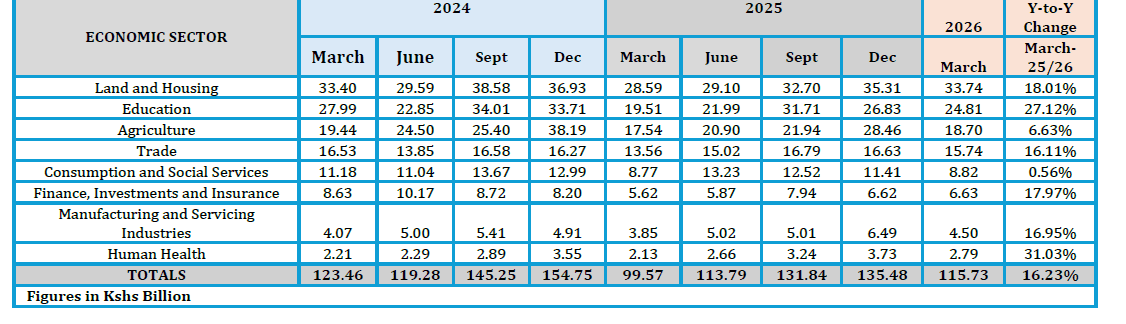
SACCO Sector loan disbursements rose 16.23% to Ksh 115.73 billion in the first quarter of 2026, the latest SACCO Societies Regulatory Authority (SASRA) Quarterly Statistical and Soundness Report shows, up from Ksh 99.57 billion in March 2025. The sectoral breakdown for the quarter to March 2026 reveals distinct growth patterns across the economy, with land and housing continuing to dominate borrowing among members.
Land and housing claimed the largest share of credit at Ksh 33.74 billion, an 18.01% jump from Ksh 28.59 billion in 2025. Within the sector, land-based credit at Ksh 18.45 billion outpaced housing credit at Ksh 15.29 billion, highlighting the sector’s central role in facilitating property acquisition for middle-income Kenyan households.
Education was the second-largest destination for credit, rising 27.12% from Ksh 19.51 billion to Ksh 24.81 billion. The surge is consistent with the January school term cycle, when demand for school fees financing peaks among members.
Human health, though the smallest sector by volume, posted the fastest growth at 31.03%, with disbursements climbing from Ksh 2.13 billion to Ksh 2.79 billion, a signal that cooperative credit is increasingly channelled toward healthcare access.
Trade received Ksh 15.74 billion, up 16.11%, with wholesale and retail accounting for Ksh 11.39 billion of that total. Manufacturing and servicing industries absorbed Ksh 4.50 billion, growing by 16.95%, with the servicing sub-sector making up 76% of the allocation. Finance, investments and insurance attracted Ksh 6.63 billion, a 17.97% increase.
Agriculture, despite positive headline growth of 6.63% to Ksh 18.70 billion, told a more mixed story beneath the surface. Crop farming declined from Ksh 13.06 billion to Ksh 10.03 billion even as animal production improved — pointing to shifting credit demand within the sector. Consumption and social services recorded the weakest growth at 0.56%, barely moving from Ksh 8.77 billion to Ksh 8.82 billion. Consumer staples fell from Ksh 4.00 billion to Ksh 3.78 billion, and consumer durables from Ksh 2.33 billion to Ksh 2.15 billion — suggesting members are prioritising productive and investment-oriented borrowing over consumption.
Sector Wealth Crosses Ksh 1.2 trillion
The lending growth comes against a backdrop of broad balance sheet expansion. Total industry assets crossed the Ksh 1.21 trillion mark, a 12.28% increase from Ksh 1.08 trillion in March 2025. Gross loans surpassed Ksh 950 billion and total deposits reached Ksh 870 billion. Total income for the quarter stood at Ksh 46.25 billion, up 18.38% year-on-year.
Deposit-Taking SACCOs (DT-SACCOs) continued to dominate, accounting for approximately 88% of total industry assets and deposits. Their total assets grew 13.05% r to Ksh 1,071.48 billion, outpacing Non-Withdrawable Deposit-Taking SACCOs (NWDT-SACCOs), which grew by 6.73% to Ksh 139.92 billion. Industry reserves rose 14.98% to Ksh 247.53 billion, with DT-SACCOs contributing 91.3% of the total.
NWDT-SACCOs total income contracted 6.47% to Ksh 4.11 billion, the only KPI among the five tracked that posted a decline.
Bad Loans
SASRA assesses sector stability through its Risk-Based Supervision framework, using the CAEL model — capital adequacy, asset quality, earnings, and liquidity.
On capital, both segments remain well-capitalized. DT-SACCOs core capital reached Ksh 199.40 billion, with Core Capital to Total Assets at 18.61% against a 10% prescribed minimum. NWDT-SACCOs maintained Core Capital to Total Assets at 12.48%, above the 8% floor.
The persistent sore point is asset quality. DT-SACCOs non-performing loans (NPLs) to gross loans stood at 6.42% in March 2026 — above the 5% regulatory ceiling, though down from a September 2025 peak of 7.17%. For NWDT-SACCOs, the NPL ratio worsened to 8.18% from 5.84% in March 2025, a meaningful deterioration. Non-Earning Assets to Total Assets for the NWDTS segment also rose to 14.37%, breaching the 10% prescribed ceiling, suggesting a growing share of the asset base is generating no income.
On the positive side, DT-SACCOs earnings improved: Return on Assets rose to 1.53% from 0.95% a year earlier, the cost-income ratio tightened to 41.53% from 43.93%, and the liquidity ratio stood at 75.95% — five times the 15% minimum. NWDT-SACCOs operating expenses consumed 26.11% of financial income, up from 22.92%, a trend regulator continues to monitor.
All figures are based on periodic statutory returns submitted to the Authority and may be subject to revision following audits and supervisory adjustments.