

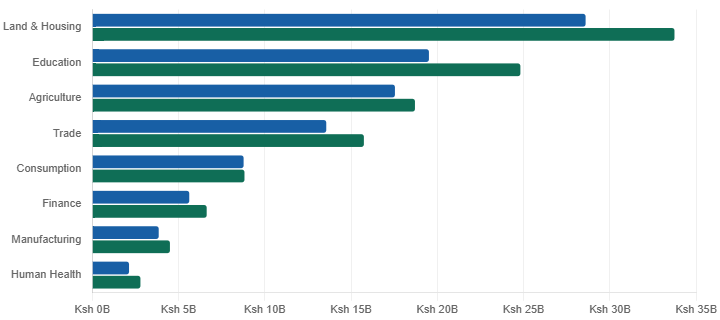
Based on the SACCO Societies Regulatory Authority (SASRA) Quarterly Statistical and Soundness Report — Quarter One, March 2026
Kenya’s regulated SACCO sector closed the first quarter of 2026 on a trajectory of broad-based expansion, with total industry assets crossing the Ksh 1.21 trillion mark, a year-on-year increase of 12.28% from Ksh 1.08 trillion recorded in March 2025. Gross loans surpassed Ksh 950 billion while total deposits reached Ksh 870 billion, signaling continued member confidence and deepening financial intermediation. Total income for the quarter stood at Ksh 46.25 billion, up 18.38% year-on-year, though the figures reflect a sector whose earnings are inherently weighted toward the second half of the fiscal year as interest income accumulates.
The data, drawn from periodic statutory reports and returns submitted to the SACCO Societies Regulatory Authority (SASRA), cover two regulated segments: Deposit-Taking SACCOs (DT-SACCOs) and Non-Withdrawable Deposit-Taking SACCOs (NWDT-SACCOs).
SASRA notes that these indicators may be subject to revision following the auditing of financial statements and supervisory adjustments.
DT-SACCOs continue to dominate the sector in absolute scale, accounting for approximately 88% of total industry assets and 88% of total deposits as of March 2026.
Summary comparison table — March 2026
| Indicator | DT-SACCOs | NWDT-SACCOs | Industry Total | YoY Change (Industry) |
| Total assets (Ksh Bn) | 1,071.48 | 139.92 | 1,211.40 | +12.28% |
| Gross loans (Ksh Bn) | 844.68 | 106.26 | 950.93 | +10.98% |
| Total deposits (Ksh Bn) | 763.52 | 106.49 | 870.02 | +11.21% |
| Total income (Ksh Bn) | 42.14 | 4.11 | 46.25 | +18.38% |
| Reserves (Ksh Bn) | 226.01 | 21.52 | 247.53 | +14.98% |
Key observations:
- DT-SACCOs grew total assets by 13.05% year-on-year, outpacing NWDT-SACCOs at 6.73%. The growth differential reflects the broader deposit mobilisation and lending activity within the DT segment.
- Total deposits for DT-SACCOs grew 11.71% compared to 7.79% for NWDT-SACCOs, consistent with the higher membership and branch penetration of the DT segment.
- NWDT-SACCO total income contracted by 6.47% year-on-year, declining from Ksh 4.39 billion in March 2025 to Ksh 4.11 billion in March 2026 — the only KPI among the five tracked that posted a decline.
- Industry reserves grew 14.98% to Ksh 247.53 billion, with DT-SACCOs contributing 91.3% of the total reserve base.
It is worth noting that from a sequential quarter perspective, DT-SACCO assets remained relatively flat between December 2025 (Ksh 1,069.05 billion) and March 2026 (Ksh 1,071.48 billion), suggesting a seasonal softening in Q1, a pattern consistent with prior years.
SASRA employs a Risk-Based Supervision framework to assess sector stability, guided by the CAEL model — covering capital adequacy, asset quality, earnings, and liquidity. The following analysis covers both the DT and NWDT segments separately.
DT-SACCOs: financial soundness
Capital adequacy
DT-SACCOs maintained a sound capital position in Q1 2026:
- Core capital reached Ksh 199.40 billion, up from Ksh 175.78 billion in March 2025.
- Core Capital to Total Assets stood at 18.61% against a prescribed minimum of 10% — well above the regulatory floor.
- Core Capital to Total Deposits was 26.12%, comfortably exceeding the 8% minimum.
- Institutional Capital to Total Assets came in at 11.79%, above the 8% threshold.
Asset quality
The non-performing loan (NPL) ratio is the most closely watched indicator of credit stress. In March 2026, DT-SACCO NPLs to gross loans stood at 6.42% — above the prescribed ceiling of 5%, though improved from the September 2025 peak of 7.17%. The December 2025 ratio of 5.41% marked the closest the segment came to the threshold within the observation window, before rising again in Q1 2026. NPLs net of provisions to core capital also improved to 5.04% from 7.30% in September 2025.
Earnings
- Return on Assets (ROA) was 1.53%, compared to 0.95% in March 2025.
- Profitability (net income before tax as a share of total income) rose to 29.70%, up from 26.69% a year earlier.
- The cost income ratio improved to 41.53% from 43.93% in March 2025, indicating enhanced operational efficiency.
- Interest margin to gross income expanded to 55.77%, the highest in the five-quarter window.
Liquidity
- The liquidity ratio stood at 75.95% against a prescribed minimum of 15% — a substantial buffer indicating robust short-term solvency.
- The technical liquidity ratio was 18.84%, and external borrowings to total assets remained low at 2.39% — well within the 25% ceiling.
- Gross loans to total deposits was 110.63%, essentially unchanged from the March 2025 level of 110.67%.
NWDT-SACCOs: financial soundness
Capital adequacy
NWDT-SACCOs maintained adequate capitalisation but at thinner margins than the DT segment:
- Core capital stood at Ksh 17.46 billion, against a minimum threshold of Ksh 5 million per entity.
- Core Capital to Total Assets was 12.48%, above the 8% floor.
- Core Capital to Total Deposits was 16.39%, exceeding the 5% minimum.
- Retained Earnings and Disclosed Reserves to Core Capital was 76.39%, comfortably above the 50% prescribed minimum.
Asset quality
Asset quality presents the most significant concern for the NWDT segment:
- NPLs (substandard, doubtful, and loss) reached 8.18% in March 2026, against a threshold of less than 5% — and higher than the 5.84% recorded in March 2025. This represents a meaningful deterioration.
- Non-Earning Assets to Total Assets rose sharply to 14.37%, breaching the prescribed ceiling of 10%. This indicator had already been elevated throughout 2025, ranging from 11.78% to 12.15%.
- Other Financial Investments to Core Capital stood at 67.44%, above the 30% prescribed limit, though down from the December 2025 high of 81.05%.
Earnings
- ROA for NWDT-SACCOs was 1.04% in March 2026, down from 1.33% in March 2025.
- Total Expense to Total Income was 53.26%, reflecting that more than half of income is consumed by expenses.
- Operating Expenses to Financial Income (OPEX ratio) rose to 26.11% from 22.92% a year earlier, a trend that warrants monitoring.
- Yield on gross loans was 3.25%, down from 3.80% in March 2025.
Liquidity
- Liquid Assets to Short-term Liabilities was 18.67%, above the prescribed floor of 10%.
- External Borrowing to Total Assets was 1.26%, comfortably below the 25% ceiling.
- Gross Loans to Deposits improved to 99.78%, the first time in five quarters the ratio dipped below 100% — meaning deposits now nominally cover the loan book without recourse to external funding.