

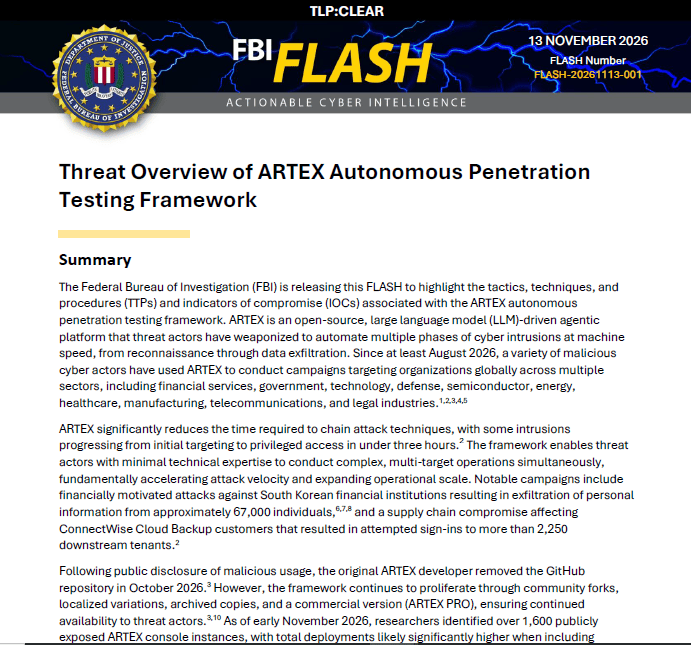
FBI warns that ARTEX, an artificial intelligence-driven hacking framework capable of breaching systems within hours, is exposing organisations with weak digital security and heavy reliance on third-party technology providers.
By Co-op News
Cybercrime is entering a more dangerous era as artificial intelligence (AI) gives hackers the ability to automate sophisticated attacks, raising fresh concerns for financial institutions, including Kenya’s Savings and Credit Co-operative Societies (SACCOs).
A cybersecurity alert issued by the United States Federal Bureau of Investigation (FBI) on November 13, 2026, warns of the growing threat posed by ARTEX, an AI-powered hacking framework that enables cybercriminals to identify vulnerabilities, infiltrate computer systems and steal sensitive information with minimal human involvement.
The open-source tool, described as an agentic platform, allows users to give instructions in ordinary language, which AI agents translate into commands to conduct reconnaissance, exploit system weaknesses, escalate privileges and extract data.
According to the FBI, the technology can compress weeks of cyber intrusion activities into hours, significantly increasing the speed, scale and sophistication of attacks.
Some reported intrusions progressed from initial targeting to privileged system access in less than three hours, demonstrating how quickly organisations can lose control of their digital infrastructure.
The development presents a particular challenge for institutions with limited cybersecurity personnel, ageing technology systems and extensive reliance on external service providers — characteristics that apply to many SACCOs and other member-owned financial institutions.
A growing threat to financial institutions
ARTEX was released on GitHub in July 2026 by a developer operating under the name Autumn-27. It was initially presented as a platform for authorised security testing and reportedly attracted between 1,500 and 2,000 stars within ten weeks.
However, following reports of misuse, the developer removed the repository on October 8. Copies of the framework remain available through community forks, archived versions and a commercial edition known as ARTEX PRO.
The framework does not have its own artificial intelligence model. Instead, it connects to external AI providers, including Anthropic’s Claude, OpenAI’s GPT, DeepSeek, GLM, Grok and Kimi.
The FBI says investigations into attacker-operated instances found that Chinese AI models, particularly DeepSeek’s Flash family, were the most commonly used. Their popularity was attributed to relatively low costs, capabilities and a lack of observable safeguards when requests were presented as penetration-testing activities.
Researchers also identified more than 1,600 publicly exposed ARTEX consoles in early November, although the actual number of deployments is believed to be considerably higher.
The FBI has documented attacks targeting financial institutions and organisations through vulnerabilities in web applications, partner platforms, cloud environments and third-party systems.
In one campaign, cybercriminals targeted South Korean financial institutions and stole personal information belonging to approximately 67,000 individuals.
In another incident, a supply-chain compromise involving ConnectWise Cloud Backup resulted in attempted sign-ins across more than 2,250 downstream tenants, highlighting the potential impact of weaknesses in shared technology platforms.
The attacks involved techniques such as exploiting authentication weaknesses, using credentials embedded in application files, abusing relationships with partner organisations and gaining elevated access to cloud and Active Directory environments.
Why SACCOs should be concerned
Although the FBI alert does not specifically identify SACCOs as targets, its findings raise important questions about the cybersecurity preparedness of member-owned financial institutions.
SACCO sector has increasingly embraced digital financial services, with institutions investing in mobile banking platforms, online member portals, automated loan processing systems and electronic payment channels.
While these innovations have improved service delivery and expanded financial access, they have also increased the number of digital entry points that criminals could exploit.
A typical SACCO may operate a mobile application, member portal, agency banking platform, legacy core banking system and several third-party integrations. Some of these systems are maintained by external technology providers, while others receive limited security attention due to budgetary and staffing constraints.
This creates vulnerabilities that automated hacking tools such as ARTEX could potentially exploit.
Smaller SACCOs may be particularly exposed because they often lack dedicated cybersecurity teams and depend heavily on outsourced ICT services. A weakness in a supplier’s systems could potentially compromise several institutions connected to the same platform.
The consequences could extend beyond financial losses. SACCOs hold sensitive member information, including identification details, account balances, loan records, transaction histories, telephone numbers and other personal data.
A successful breach could expose confidential information, facilitate fraudulent transactions, disrupt services and undermine members’ confidence in their institutions.
For a sector whose strength is built on trust, protecting members’ information is therefore both a financial and governance responsibility.
Cybersecurity must become a boardroom priority
The FBI has outlined several measures organisations should adopt to reduce exposure to ARTEX-related attacks and other automated cyber threats.
These include identifying and regularly reviewing all internet-facing systems, particularly forgotten portals, legacy applications and third-party integrations.
Institutions are also advised to strengthen access controls, restrict administrative interfaces to trusted networks, apply the principle of least privilege and regularly review permissions granted to applications and external service providers.
Other recommended measures include monitoring unusual login attempts, setting limits on transactions and data requests, removing exposed passwords and credentials from application files, and ensuring that sensitive technical information is not accessible to unauthorised users.
For SACCO boards and management teams, these recommendations reinforce the need to elevate cybersecurity beyond the ICT department.
Boards should ensure that institutions conduct regular security assessments, establish clear technology risk-management policies and scrutinise the cybersecurity arrangements of vendors handling members’ information.
Staff training is equally important, as human error and weak security practices can create opportunities for cybercriminals.
Institutions should also maintain reliable data backups and regularly test incident-response and recovery plans to minimise disruption in the event of an attack.
An opportunity for collective action
The growing sophistication of AI-driven cybercrime also presents an opportunity for greater cooperation within the co-operative movement.
Through federations, apex organisations and industry associations, SACCOs could strengthen collective cybersecurity preparedness by sharing threat intelligence, establishing common security standards and exploring affordable shared monitoring and incident-response services.
Such arrangements would help smaller institutions access cybersecurity capabilities that might otherwise be beyond their individual budgets.
The FBI has urged organisations that identify ARTEX-related activity to report it to their local FBI field office or through its Internet Crime Complaint Center (ic3.gov). It has also cautioned that published malicious IP addresses may be reassigned and should be verified against current security information before being blocked.
As Kenya’s SACCO sector continues investing in digital transformation, the ARTEX warning serves as a timely reminder that technological growth must be matched by stronger security systems.
AI is making cyberattacks faster, cheaper and more accessible to criminals. For SACCOs, the challenge is no longer simply whether they can afford to invest in cybersecurity, but whether they can afford the consequences of failing to protect their members’ money and personal information.
Ultimately, the security of a SACCO’s digital ecosystem may depend on its weakest system, least-protected portal or most vulnerable technology partner.