

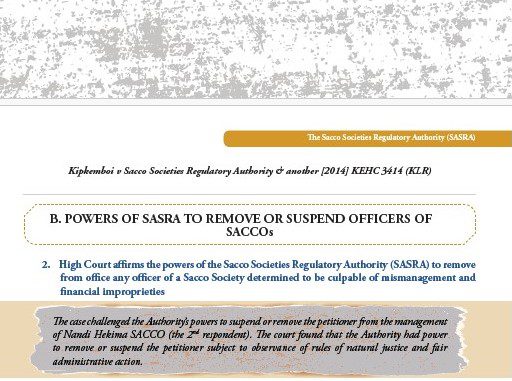
POWERS OF SASRA TO REMOVE OR SUSPEND OFFICERS OF SACCOs
Kenya’s savings and credit cooperative sector manages billions of shillings in member deposits, making it one of the most consequential corners of the country’s financial landscape. Yet for years, a critical question lingered in boardrooms and courtrooms alike: could the Sacco Societies Regulatory Authority (SASRA) remove or suspend a Sacco officer, even one it did not employ, when misconduct was suspected?
The newly released Cooperative Financial and Sacco Law Case Digest Volume 1 by SASRA settles that debate decisively. Drawing on a series of rulings from Kenya’s High Court and Court of Appeal, the digest confirms that SASRA wields broad, legally sound powers to act against errant officers in the interest of member protection and sector stability. The cases documented, spanning over a decade of litigation, form a coherent body of precedent that every Sacco board member, compliance officer, and legal practitioner should understand.
What the Law Actually Says
SASRA’s enforcement authority rests on two primary pillars: the SACCO Societies Act (Cap 490B) and the SACCO Societies (Deposit-Taking Business) Regulations, 2010.
Section 51(c) of the Act is the cornerstone provision. It empowers SASRA – upon determining that a Sacco is conducting business in a manner contrary to the law, detrimental to member interests, or while undercapitalized – to “direct the suspension or removal of any officer involved in such conduct from the service of society.”
This statutory power is reinforced by Regulation 67(4), which authorizes SASRA to “issue administrative directions” or “impose such sanctions” against any officer it has reasonable grounds to believe is engaged in, or likely to engage in, conduct that contravenes the law or harms the Sacco’s members or survival. Regulation 72(6) goes further, specifying the grounds for removal: violation of the Act or bylaws, unsafe or unsound practices, holding non-performing loans, and breaches of fiduciary duty likely to cause financial loss or prejudice member interests.
Critically, Regulation 72(3) stipulates that a person removed under these provisions is ineligible to hold office in any Sacco for at least three years — a powerful deterrent against serial misconduct.
The Landmark Cases
Kipkemboi v SASRA
The foundational case in this body of law arose from Nandi Hekima SACCO in Eldoret. In 2012, SASRA suspended Silas Kipkemboi, the Sacco’s Chief Executive Officer, on allegations of financial mismanagement and impropriety. He was given 15 days to respond to the charges — and did not.
When the matter came before Justice K. Kimondo at the High Court (Constitutional Petition 5 of 2013), Kipkemboi argued that SASRA’s action was unlawful and violated his constitutional rights to fair hearing and fair administrative action under Articles 47 and 50 of the Constitution.
The court was unpersuaded. In a judgment delivered on August 4, 2014, Justice Kimondo held that Sections 50 and 51 of the SACCO Societies Act, read together with Regulations 67 and 72, “granted the Authority enormous powers over the management of SACCOs.” Those powers — ranging from inspection to licence revocation to board reconstitution — had to be understood in the context of prudent Sacco management and the security of depositor funds. The petition was dismissed with costs; the petitioner, as the judge memorably put it, “slept on his rights and was the author of his own misfortune.”
Analyzing SASRA’s Legal Mandate to Suspend and Remove Sacco Officers.
When a regulator moves to oust a Sacco chief executive or director, does the law back it up? A review of landmark Kenyan court rulings says, unequivocally, yes — provided due process is followed. A Watchdog with Real Teeth
The Court of Appeal
Kipkemboi appealed. Before a three-judge bench comprising Justices MGithinji, Okwengu, and Mohammed (Civil Appeal 76 of 2015), he raised a novel argument: SASRA could not lawfully suspend or remove him because it was not his employer. The Employment Act, he contended, reserved that power for employers alone.
The Court of Appeal dismissed the appeal in May 2018, producing arguably the most significant ruling in this area of law. The court reasoned that Section 92(2) of the Employment Act itself provides a saving clause — its provisions apply “in addition to, and not in substitution for… the provisions of any other Act.” Because Section 51(c) of the SACCO Societies Act expressly conferred removal powers on SASRA, the regulator’s action was “consistent with the exception” in employment law. The employment relationship between Kipkemboi and the Sacco was simply no bar to SASRA’s statutory mandate.
Republic v SASRA ex parte John Korir
A parallel case from the same Nandi Hekima SACCO arose when a director, John Korir, sought judicial review orders to quash his removal and bar SASRA from relying on the report recommending it. Justice HA Omondi, sitting at the High Court in Eldoret in 2019, dismissed the application. The court reaffirmed that judicial review concerns the process of decision-making, not its merits. Since Korir had been issued a letter setting out the grounds for his removal and had chosen not to respond, his claim of denied fair administrative action was, in the court’s words, “unfounded.”
Why These Powers Exist
The breadth of SASRA’s enforcement powers is not accidental. It reflects a deliberate policy choice to protect millions of Kenyan Sacco members — many of them ordinary wage earners, farmers, and traders — whose deposits and savings are held in trust by these institutions.
The Nandi Hekima cases illustrate the kinds of risks that prompted Parliament to legislate so robustly. In that Sacco, the courts heard that loans had been advanced on land purchased by the Sacco but registered under a separate company, that the directors of the two entities overlapped, and that proper shareholding records were absent. These were not technical infractions — they were the hallmarks of governance failure capable of wiping out member savings.
In this context, the principle undergirding SASRA’s enforcement mandate is straightforward: where internal governance breaks down and a Sacco’s own members or board cannot — or will not — act, the regulatory authority must be empowered to intervene. The alternative, a regulator that can inspect and advise but cannot compel personnel changes, would be a watchdog without a bite.
Counterbalance
The courts have been equally clear that SASRA’s powers, however broad, are not absolute. In every case reviewed in the digest, the pivotal question was whether the officer in question received adequate notice and a genuine opportunity to respond before removal.
The Fair Administrative Action Act and Article 47 of the Constitution require, among other things, prior and adequate notice of the proposed action, an opportunity to be heard, a statement of reasons, and notice of appeal rights. In the Kipkemboi cases, SASRA satisfied these requirements — providing detailed letters specifying the grounds for suspension and removal, setting response deadlines, and serving removal letters through a court process server. The Court of Appeal specifically noted that the appellant received a four-page letter detailing grounds for suspension and a six-page letter containing detailed reasons for removal.
The lesson for SASRA is as important as the lesson for Sacco officers: enforcement powers are constitutionally conditioned on procedural fairness. An action taken without adequate notice or opportunity to respond would be vulnerable to legal challenge, regardless of how serious the underlying misconduct.
For Sacco boards and management, SASRA’s oversight is not ceremonial. An officer who receives a show-cause letter from the regulator must take it seriously, respond substantively, and seek legal counsel if necessary. Silence, as these cases show, is not a defensible strategy.
For legal practitioners advising Saccos or their officers, the employment law angle is now settled — the regulatory removal power under Section 51(c) operates independently of any employment contract or the Employment Act’s standard procedural requirements. Challenges must be grounded in procedural fairness arguments, not jurisdictional ones.
For the investing public and Sacco members, the rulings offer assurance that an effective legal architecture exists to protect their deposits. SASRA has the authority, confirmed at the appellate level, to act decisively when officers engage in conduct detrimental to member interests.
The cases also signal that courts will not lightly interfere with SASRA’s exercise of this mandate, provided the regulator follows due process.
The Cooperative Financial and Sacco Law Case Digest Volume 1 is published by the Sacco Societies Regulatory Authority (SASRA) as a reference resource for legal practitioners, industry stakeholders, and the public.