
Cooked Books, Broken Trust
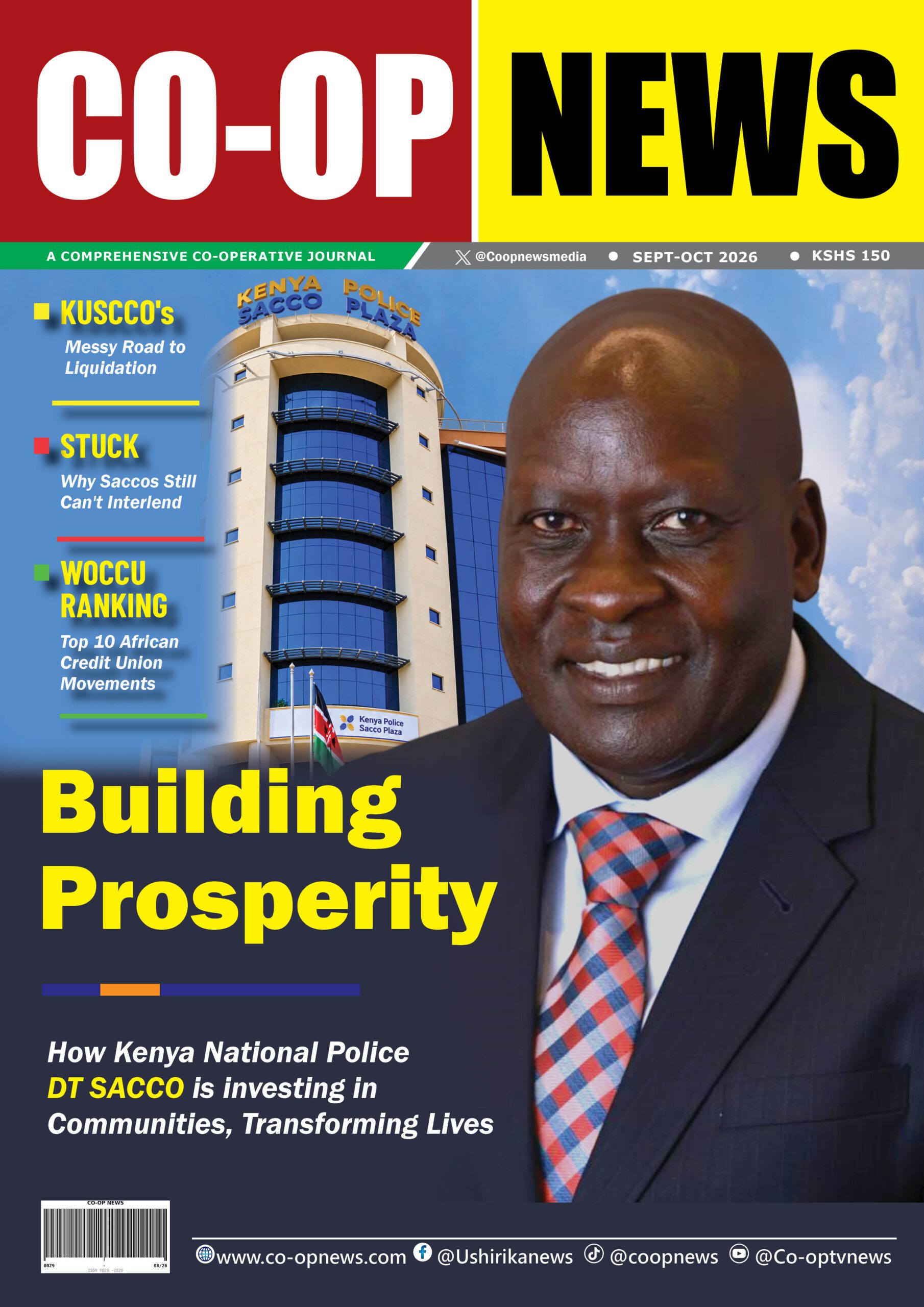
For more than five decades, the Kenya Union of Savings and Credit Cooperatives (KUSCCO) stood as the beating heart of country’s cooperative movement, the umbrella body that thousands of Saccos trusted to hold their money, train their staff, and speak for them in the corridors of power.
Today, that heart has stopped. What remains is a trail of forensic audit reports, more than 200 court cases, and a bitter question that stakeholders kept repeating at a packed meeting in Nairobi recently: how did it come to this?
KUSCCO’s troubles have accumulated gradually. They began, investigators say, with numbers that did not add up. An inspection launched in 2023, after members complained they could not access their investments, found that the Union’s loan book had been inflated by more than KSh7.6 billion.
Forensic auditors from Grant Thornton LLP and PwC were called in, and what they uncovered painted a picture of an institution that had been quietly hollowed out from within, systematic gaps in how resources were managed, and financial records so “creative” that court documents would later cite them as evidence of deliberate misstatement.
By the time the full scale of the rot was tallied, the figures were staggering. Over KSh12 billion in Sacco deposits had been swallowed by the scandal. Of the claims lodged by member Saccos seeking to recover their money, only about KSh6 billion could be verified according to a current report by the Union CEO Arnold Munene.
The taxman came knocking too: the Kenya Revenue Authority slapped the Union with a KSh1.25 billion tax demand, calculated on the back of the very “cooked books” that union officials had used to report profits that never existed.
The asset picture told its own story of decline. In 2022, KUSCCO’s verified assets stood at a healthy KSh12 billion. Two years later, that figure had shrivelled to KSh4.7 billion, a collapse that mirrored the unravelling confidence of the Saccos that once trusted it with their members’ savings.
Death Spiral
What began as an estimated KSh5 billion shortfall quickly metastasised. By the time stakeholders convened to decide the Union’s fate, the operating deficit had ballooned past KSh14 billion, and by other internal reckonings, beyond KSh15 billion. Legal claims against the Union in various courts amounted to KSh6.4 billion, with more than 200 separate cases clogging the judicial pipeline.
Commissioner for Cooperative Development David Obonyo, who has overseen the government’s intervention, described a union caught in a vicious cycle: efforts to revive it were being undercut by stakeholders who, sensing the ship was sinking, rushed to court to secure their own money ahead of everyone else.
Some of those court orders directed the auction of KUSCCO’s assets outright. Complicating matters further, the Union’s remaining assets carried a bank loan attached to them, and in insolvency law, banks do not queue with everyone else. Secured creditors sit at the very top of the repayment hierarchy, ahead of depositors and unsecured claimants, under frameworks such as the Kenya Deposit Insurance Act and the broader Insolvency Act. For ordinary Saccos hoping to recover their members’ savings, that legal reality meant the scramble for KUSCCO’s remaining value was never going to be an equal race.
The desperation spilled beyond the courtroom. Stakeholders spoke of Saccos refusing arbitration altogether, going straight to litigation, and, in claims that could not be independently verified, even hiring goons to force their way into KUSCCO premises to seize property. Reports of enforcement attempts turning physical underscored just how frayed relations between the Union and its members had become.
Among the disputes was a ruling by the Co-operative Tribunal ordering KUSCCO to refund KSh489 million to a Sacco over matured fixed-deposit investments that had gone unpaid, one of many similar claims still winding through the system.
‘The Funeral’
The reckoning came at a Special General Meeting in Nairobi, convened by Commissioner Obonyo, where stakeholders from across the cooperative movement gathered not to plan a rescue, but to preside over a burial. The mood in the room left little room for sentiment.
Speaker after speaker rose to demand accountability. “Why pay to be trained by KUSCCO, on what?” one exasperated stakeholder asked, dismissing the Union’s remaining training mandate as a hollow proposition.
Others were blunter still, insisting that those responsible for the collapse be “brought to book to deter others” from repeating the same mismanagement in future.
Doubts extended even to the institution’s current leadership. Some questioned aloud whether there was any real guarantee that the present board would fare better than the one that had presided over the scandal, a scepticism that spoke to just how deep the erosion of trust had run. Many Saccos made clear they were no longer willing to prop up the Union in any form. For them, the meeting was not a strategy session. It was, as some put it starkly, KUSCCO’s funeral, with no hope of resurrection.
The State Department for Cooperative Principal Secretary Patrick Kilemi tried to reframe the resistance, telling stakeholders that court challenges to the government’s clean-up efforts were, in effect, working against their own interests.
“When many of you are raising money to block the very key work we are trying to do to prevent this from ever happening again,” he asked, questioning why members would fund litigation against the very reforms meant to protect them.
Union Interim Board chairman David Mategwa struck a more wistful note, noting that the interim leadership had served without any facilitation from KUSCCO itself.
He reminded the stakeholders that no country’s Sacco movement could thrive without a national umbrella body. “We have a good name, globally, as a country. As SACCO practitioners, my request is, please think about what we should do,” he appealed.
Mr Obonyo defended his office’s record, noting it was his team that had first flagged the rot inside KUSCCO. “It was very clear that there is a problem that needs to be sorted out,” he said, adding that government alone could not resolve the crisis without the full participation of the Saccos that owned the Union. He noted some had even retained officials who were suspended from the Union leadership
At the Meeting held at All Saints’ Cathedral in Nairobi, shareholders were presented with a financial report that told the whole story: an asset base of roughly KSh5.4 billion set against liabilities exceeding KSh17 billion. The math was unforgiving, and shareholders voted to approve KUSCCO’s structured liquidation.
The Commissioner was formally mandated to oversee an orderly wind-down, securing and realising the Union’s remaining assets, settling liabilities and liquidation costs, and distributing whatever proceeds remained, strictly according to the law.
A New Federation
Yet even in dissolution, stakeholders were not willing to let the Sacco movement go without a national voice. Seven cooperative leaders were tasked with working alongside the Commissioner’s office to steer the transition. Commissioner Obonyo has urged cooperatives to organise themselves swiftly around the new federation, pledging his office’s support to see the process through.
The Kenya Federation of Savings and Credit Cooperatives (KEFESCO) Ltd, was proposed as the successor, envisioned as a leaner organisation focused on advocacy, education and training, research, and consultancy for the sector.